Monday, April 2, 2018

Do Gymnosperms Have Flowers or Pollen

Gymnosperms have pollen but no flowers. Pollen is made by the male cones from microspores that come from microsporocytes created during meiosis. Using the wind, the pollen granules pollinate the female cones. Gymnosperms came into existence in the early Mesozoic era about 359 to 299 million years ago. They are the ancestors of the flowering angiosperms that appeared around 145.5 to 65.6 million years ago during the late Mesozoic era.


Over millions of years, early plants developed seeds and pollen as adaptations to drought conditions and this is the origin of gymnosperms. Their ability to reproduce and for embryos to grow without water also paved the way for them to eventually colonize dry land. Before this, fossil evidence shows that certain extinct species of scorpionflies used their proboscises to pollinate extinct progymnosperms (their predecessors) during the middle of the Devonian period from 419.2 to 358.9 million years ago.


As the organisms on the planet evolved and biodiversity exploded, angiosperms came on the scene and evolved flowers to attract bees and other pollinators. They also started to develop fruits to allow animals to help disperse their seeds. Although there are over 260,000 species of angiosperms today compared to about 1,000 species of gymnosperms, the gymnosperms are just as important in the evolutionary history and diversity of the planet.


Cryptomeria japonica cones

The image above shows the male (lower) and female cones of the Japanese Cedar tree Cryptomeria japonica.


References


  • OpenStax College. (2017). Concepts of Biology. Houston, TX. Open Stax CNX. Retrieved from http://cnx.org/contents/b3c1e1d2-839c-42b0-a314-e119a8aafbdd@9.39


Do Gymnosperms Have Flowers or Pollen

Characteristics of Gymnosperms

The word gymnosperm comes from the Greek words gymnos meaning “naked” and sperm which means “seed.” So, plants that are gymnosperms have naked seeds which distinguishes them from angiosperms whose seeds are enclosed in a fruit or ovary. Gymnosperm plants first evolved in the Carboniferous period around 359-299 million years ago. Today, there are about 1,000 species categorized into 4 divisions: Cycadophyta, Coniferophyta, Gnetophyta, and Ginkgophyta.


Gymnosperms have needle-like or scale-like leaves and no flowers. The leaves have a waxy cuticle that reduces water loss and helps snow to slide off easily, reducing the weight load on the branches. Their wood is softer than that of angiosperms and is used to make paper and lumber. Most gymnosperms are evergreens meaning they don’t lose their leaves seasonally but there are a few species like the larch and tamarack that are deciduous. Gymnosperms are also perennials, growing back every year with no need for replanting.


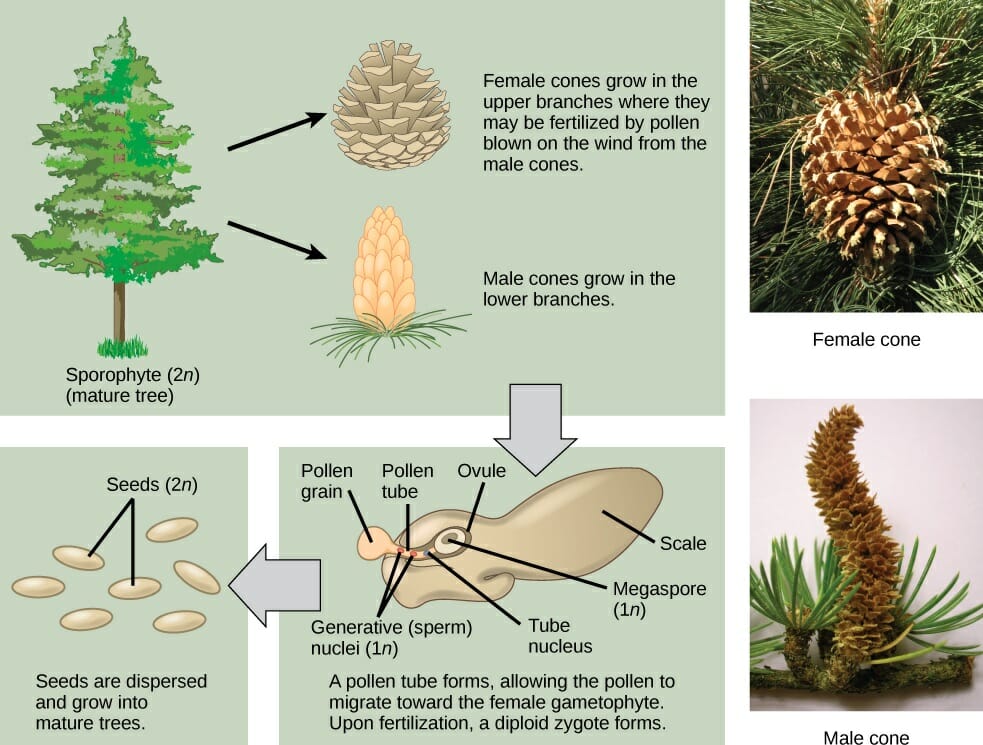
The reproductive system of gymnosperm plants is located in the cones. For example, in conifers, the dominant phylum of gymnosperms, there are female cones that grow in the upper branches of the tree and male cones grown on the lower branches. Pollination is done mostly by the wind, carrying the male pollen grains to fertilize the megaspores on the female cones.


male cones pollen fertilizes

The image above shows the male and female cones of a coniferous gymnosperm and how the male pollen fertilizes the female megaspore.


References


  • OpenStax College. (2017). Concepts of Biology. Houston, TX. Open Stax CNX. Retrieved from http://cnx.org/contents/b3c1e1d2-839c-42b0-a314-e119a8aafbdd@9.39


Characteristics of Gymnosperms

Angiosperm vs Gymnosperm

Angiosperms and gymnosperms are two types of seed plants as shown by the suffix sperm which means “seed” in Latin. Gymnosperms first appeared on Earth during the Carboniferous period about 359-299 million years ago and they dominated the landscape by the Mesozoic era 251-65.5 million years ago. By the end of the Mesozoic era, angiosperm plants had taken over and they remain the most successful terrestrial plant group.


There are about 1,000 species of gymnosperms classified into 4 divisions: Coniferophyta, Cycadophyta, Ginkgophyta, and Gnetophyta. Plants in the Gnetophyta division are most closely related to angiosperms because they have xylem tissue. The Latin prefix gymnos means “naked” and refers to the seeds of the plants which are not enclosed in a fruit like angiosperm seeds are.


Angiosperms number over 260,000 species, second only to insects in terms of their diversity. The species are divided into monocots that have a single cotyledon and dicots (also called eudicots or true dicots) with two cotyledons. Monocots and dicots are identified, among other things by looking at their leaves. Monocots have parallel veins in their leaves while the veins in dicot leaves are branched. Their root systems are also different. Monocots have a network root system and dicots have a main taproot with lateral roots coming out of it.


Comparison Chart


AngiospermsGymnosperms
SeedsYes, usually inside an ovary (fruit)Yes, not enclosed, usually found on cones, scales, or leaves
LeavesFlatNeedle-like or scale-like
Has Flowers?YesNo
Reproductive SystemIn the flowers, unisexual or bisexualUnisexual system in the cones
Type of WoodHardwoodSoftwood
UsesFood, medicines, clothingLumber, paper
Ploidy (number of sets of chromosomes)TriploidHaploid
Perennial?NoYes
Life CycleSeasonal, plant dies in autumnEvergreen
Pollination MechanismMostly by animalsMostly by the wind

Gymnosperms and angiosperms thumb

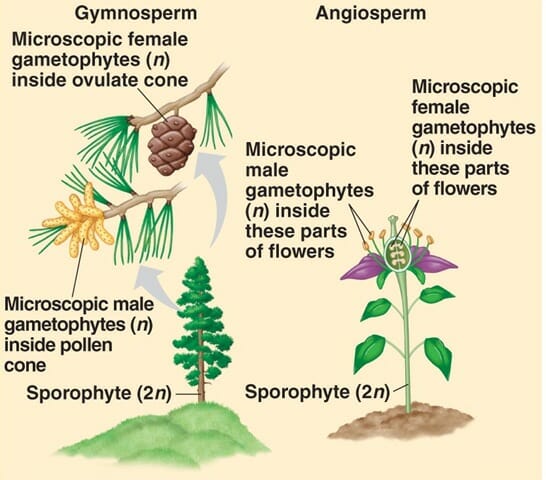
The image above compares the reproductive systems of angiosperms and gymnosperms.


References


  • Angiosperms vs. Gymnosperms. (n.d.). In Diffen.com. Retrieved from https://www.diffen.com/difference/Angiosperms_vs_Gymnosperms

  • OpenStax College. (2017). Concepts of Biology. Houston, TX. Open Stax CNX. Retrieved from http://cnx.org/contents/b3c1e1d2-839c-42b0-a314-e119a8aafbdd@9.39


Angiosperm vs Gymnosperm

Fluoride

Fluoride Definition


Fluoride is a negatively charged fluorine atom (F), also known as a fluorine anion. Fluoride is a naturally occurring ion, found in certain mineral and salty deposits. Certain levels of fluoride have been proven to be beneficial in fighting cavities and strengthening teeth. As a public health measure, fluoride has been maintained at low levels in municipal drinking water in many countries, including Australia, the United States, and several European countries. While there remains some controversy over the dangers of fluoride in water, the level is maintained well below the documented level at which negative symptoms are seen.


Biochemistry of Fluoride


Fluoride, as a negative ion, or anion, is capable of binding ionically to a cation, or positive ion. In the blood, there are many cations, but of utmost importance are H+ (hydrogen) and Ca2+ (calcium). These cations must be maintained in strict balance. If they are not in balance, the system will become more acid, and more calcium will be drawn from the bones and teeth, making them weaker and brittle. If a person has two little fluoride or too much fluoride in their system, these cations will also become unbalanced.


On the short hand, too little fluoride creates weak teeth, and allows bacteria to infiltrate and infect. This leads to tooth decay and cavities. Very low levels of fluoride prevent calcium from leaving the teeth, thereby strengthening them and preventing bacterial invasions. It is for this reason that water supplies are fluorinated on purpose. Fluoride provides an efficient, cost-effective method of providing a basic preventative health service.


On the other hand, too much fluoride in the system can be a bad thing. Just as too little fluoride weakens the bones, too much fluoride causes the same condition. Instead of limiting the system which balances calcium in the bones and teeth, fluoride can become the negative anion which pushes it out of balance. With too much fluoride in the system, the pH begins to lower. This causes the release of calcium, which can soak up acids in the blood. The calcium is then lost in the urine, and the bones and teeth become weaker.


Your body has this natural ability to process and remove excess fluoride, and can expel up to 50% of the fluoride intake per day. However, this means that long exposures to medium doses or single exposures to very high doses will take time to be removed from the system. At a certain point, they can become deadly, but this point is far above the threshold we keep our fluoride levels at.


Uses for Fluoride


Fluoride in Drinking Water


Health professionals have been maintaining low levels of fluoride in drinking water for many decades, as there is much evidence that it decreases tooth decay by killing bacteria in the mouth. The low levels of fluoride added to drinking water are far below the maximum limits of 7-10 mg per day that a human can safely consume. While many millions of people drink fluorinated water, controversy remains around its effects and potential side-effects. Much of this is due to the harsh effects of fluoride at high levels, seen in some natural ground water sources. Municipal sources of water are specially treated and screened to prevent high levels of fluoride. See “Dangers of Fluoride” below, for more information.


Fluoride in Dental Products


Fluoride is a common component in many dental products, including toothpastes, varnishes, and other teeth cleaning products. Fluoride has a proven history in the fight against mouth disease. It is also incredibly cheap, and reliable to work with. However, in the early days of using fluoride in dentistry there were some unfortunate accidents. Several people got sick, and even died, when they misused concentrated fluoride solutions provided by their dentists. While the solutions were intended to be spit out, the patients swallowed the concentrated fluoride. The high dose of fluoride disrupted their pH and calcium content enough to cause death.


These situation have been easily avoided by the setting of guidelines to the use of fluoride and strict warning labels on products which contain fluoride. Fluoride toothpastes usually contain a fraction of the daily advised amount of fluoride, and most of the fluoride is not absorbed when properly used. Concerns over children and fluoride poisoning have led to children’s toothpastes, which have a reduced fluoride content.


Other Places Fluoride is found


Fluoride is found naturally nearly everywhere. There is fluoride present in seawater, at nearly the same levels government fluorine their water. There is also some present in rainwater, which has fallen from the atmosphere after being deposited there by fires, volcanoes, and industrial pollution. The majority of fluoride on the Earth is found as the salt crystal fluorite (CaF2). This crystal can be mined, and the fluoride can be extracted for industrial applications. Because fluoride is found in rain and water, it is also found in plants. Therefore, everything we eat has trace amounts of fluorine.


Dangers of Fluoride


While there are virtually no well documented dangers to the levels of fluoride we are exposed to in the water, there is a danger of having no or too much fluoride. Fluoride is a necessary part of several biological reactions, and most living organisms need at least trace amounts of it to function properly. Where this threshold is exactly is not known, but even as little as half a milligram per liter of water can drastically improve bone and tooth health.


On the flip side, too much fluoride can have drastic consequences. Beginning symptoms of excess fluoride include dental and skeletal fluorosis. This is a condition in which the calcium starts to leave the bones to deal with the excessively high blood pH. As the calcium leaves, it is replaced by fluorine. This can make the bones and teeth excessively hard and brittle, causing them to break or shatter more easily. These symptoms can be slowly reversed by cutting fluoride out of the diet. These diseases have been documented in cases where the fluoride in the drinking water was above 10 mg/L, which is almost 10 times the amount in North American drinking water.


Exposure to higher levels of fluoride can cause more severe symptoms. At the far end of the spectrum is hypocalcemia. Your body, in order to counterbalance the huge amount of negation ions you just ingested, rapidly pulls the calcium from all of your tissues, not just the bones and teeth. As this happens, critical junctions at nerve and muscle cells can no longer function. Your body shuts down quickly, and you die. This condition is known as hypocalcemia. Fluoride has caused several deaths this way, mostly in accidents involving concentrated fluoride chemicals for industrial purposes. While fluoride is not a problem for nations with sophisticated water treatment facilities, high levels of fluoride are consumed by over 300 million people a year from untreated groundwater sources.


In drinking water in the United States, the fluoride is maintained between 0.7 and 1.2 mg per liter. A human can drink around 3-4 liters of water per day, which brings their total fluoride intake to somewhere between 4-5 mg. A daily intake of less than 10 mg is recommended, allowing much room before significant levels of fluoride are reached. In groundwater sources which contain more fluoride than this, the fluoride can quickly accumulate and cause a wide variety of issues.


Quiz


1. Is fluoride harmful or beneficial to your health?
A. Harmful
B. Beneficial
C. It depends how much you take

Answer to Question #1

2. Which of the following is a serious concern about fluoride?
A. The Communists are using it to control our brains
B. Too much fluoride will cause mutations and deformations
C. Too little fluoride will leave us with brittle bones and teeth

Answer to Question #2

3. Fluorite (CaF2) is the salt crystal which is mined to extract fluoride. Approximately how much fluoride is obtained from two grams of fluorite? Hint: you might want to look at the periodic table.
A. 0.25 grams
B. 1 gram
C. 1.5 grams

Answer to Question #3

References


  • Bruice, P. Y. (2011). Organic Chemistry (6th ed.). Boston: Prentice Hall.

  • Nelson, D. L., & Cox, M. M. (2008). Principles of Biochemistry. New York: W.H. Freeman and Company.


Fluoride

Bilirubin

Bilirubin Definition


Bilirubin is a molecule formed from the breakdown of red blood cells, and other cells with porphyrins. Red blood cells carry special molecules, called hemes (a type of porphyrin), which hosts an iron atom. This arrangement allows the red blood cell to carry oxygen. When blood cells break down, they release the heme into the blood, which could do damage if not controlled.


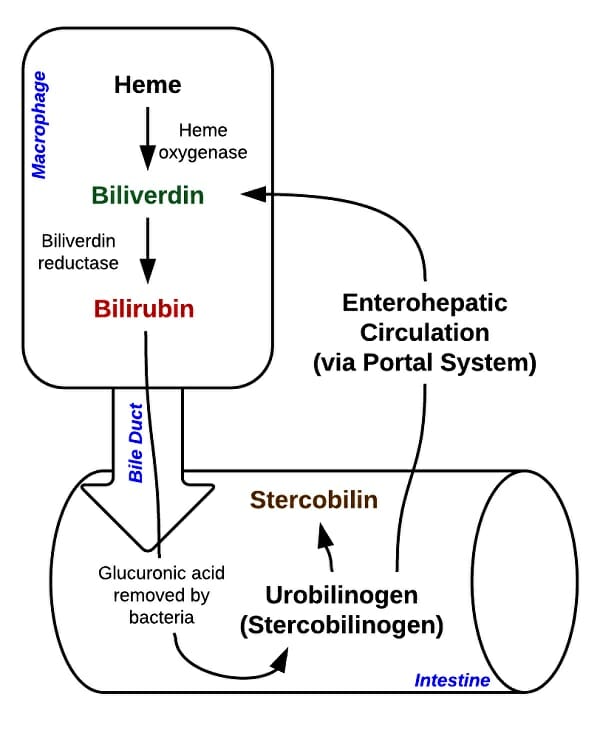
Heme is actively broken down in the liver, as seen in the image below. It is first converted into biliverden. Another enzyme continues the process, and converts biliverden into bilirubin. Bilirubin is then deposited into the intestines, via the bile duct. From there it can be excreted in the urine or in the feces. In the intestines it is converted to stercobilin, a reddish-brown substance that gives feces its distinct coloration. In the urine, bilirubin becomes urobilin, a very yellow substance.


Heme Breakdown


Bilirubin, because it is related to porphyrin molecules, is a natural pigment. As it changes into different molecules and versions, it also changes color. Scientists can use these colors to detect disease. For instance, a bruise is caused by the pooling of blood under the skin. Pooling blood is a dark red or purple, and will slowly turn more brownish as the iron oxidizes. As the blood is removed and recycled, the heme groups must be broken down. Heme is first converted to biliverden, which has a greenish tint. If you’ve ever had a large bruise that appeared greenish, this is why. After this, it is converted to bilirubin, and has a distinctive yellow color. Old bruises will turn this distinctive yellow before disappearing.


The distinctive yellow coloration of bilirubin buildup is a common symptom of conditions like jaundice, in which bilirubin builds up all over the body. This can happen in babies, when the liver has not yet fully developed, or in adults with non-functioning livers. While the yellow coloration of the eyes and skin is a definite sign that something is drastically wrong, a bilirubin test can show the levels of bilirubin long before they become dangerous.


Bilirubin is also found in plants, as a breakdown product of chlorophyll, a molecule highly related to the heme molecules in animal cells. It is also very similar to the pigment phycobin, which is used by autotrophic bacteria to capture energy from sunlight.


Bilirubin Test


Conjugated versus Unconjugated Bilirubin


Bilirubin exists in multiple forms in your blood. It exists in a water-soluble form, which is attached to glucuronic acid in the liver by a special enzyme. This makes bilirubin easier to detect and is known as conjugated bilirubin. Unconjugated bilirubin, on the other hand, is fat-soluble, which makes it harder to detect in solution. As such, some of this bilirubin is undetectable. It bonds to itself and other fat-loving molecules.


Therefore, a test of a person’s total bilirubin includes the direct measurement of soluble bilirubin, plus the estimated indirect bilirubin. These two forms, and their abundance in the system, can tell a doctor a lot about which process may be getting interrupted in the liver. For instance, a healthy person will have a higher concentration of unconjugated bilirubin, but the exact levels depend on the person and circumstance.


Normal levels for total bilirubin can be anywhere from .1 to 1.2 milligrams per deciliter of blood, and the direct bilirubin will only be .1 to .4 mg/dL of that. Conditions of hyperbilirubinemia, or a really high bilirubin level, can happen for many reasons. The total blood bilirubin would have to be much higher than this before this condition would start to appear. Typically, around 10 mg/dL symptoms of bilirubin buildup, such as jaundice of the eyes and skin can be seen. This is around 10 times the regular levels.


It could be caused by rapid blood cell loss, a non-functioning liver, or a variety of other condition which stop the liver or other organs from properly processing bilirubin. This condition could also be caused by a blockage of the bile duct, hepatitis, or certain pharmaceuticals which are interfering with the passage or conversion of bilirubin. Your doctor will have many other tests to take into consideration, as your bilirubin levels can indicate many different conditions.


Urine Bilirubin Test


Healthy people do not normally excrete bilirubin in the urine. It is normally converted to another chemical, which is much more water soluble. Bilirubin in the urine is a symptom of a number of liver, kidney, and intestinal diseases in which a biological process is being obstructed. Finding bilirubin in the urine can help a doctor differentiate where in the excretory system the error is occurring. There are many factors which will help determine this, including the type of bilirubin found and its quantity.


Quiz


1. Why is bilirubin yellow and biliverden green?
A. The structure of their bonds
B. The energy they give off
C. It’s their favorite color!

Answer to Question #1

2. What do chlorophyll, heme, and bilirubin all have in common?
A. Nothing
B. They are all pigments
C. They are all porphyrin rings

Answer to Question #2

3. Newborn babies often become “jaundiced” or very yellow after birth. Why is this?
A. They genetically can’t process bilirubin
B. The liver is not yet fully developed
C. It is perfectly natural and not harmful

Answer to Question #3

References


  • Bruice, P. Y. (2011). Organic Chemistry (6th ed.). Boston: Prentice Hall.

  • Nelson, D. L., & Cox, M. M. (2008). Principles of Biochemistry. New York: W.H. Freeman and Company.


Bilirubin

Toxin

Toxin Definition


A toxin is a chemical substance which damages an organism. A toxin may be as simple as an ion or atom which negatively interferes with a cell. A toxin can also be in the form of complex molecules such as the proteins found in snake venom. Still other atoms and chemicals emit radiation, which has toxic effects on an organism. The effects of toxins vary widely in different organisms, and with different toxins. The end result of the strongest toxins is death, due to the damage they cause across the different cells of an organism. Different toxins act in different ways to affect the cells they damage.


In the study of Toxicology, the central motto is that, “all substances are toxic, it is only the dose which matters.” This fact can be demonstrated with water and oxygen. Both substances are normally good and we consider them beneficial for all forms of life. If your body holds too much water, your individual cells will not be able to operate efficiently and your body will slowly “drown”, even if you aren’t submerged in the water. And oxygen, the live giving gas, can be fatal at certain pressures.


Effects of a Toxin


The effects of a toxin are entirely determined by the biochemical reactions which take place when a potential toxin is introduced into an organism. Toxicologists must also take into consideration the environment in which the organisms lives. As mentioned before, things like pressure, heat, and metabolic rate can drastically change the effects of a toxin. Further, not all organisms react to toxins in the same way. Each organisms, even within a species, is essentially a unique biochemical factory. Some organisms are better equipped to handle certain toxins than others.


The specific effects of a toxin are determined by how it interacts with the cells of the organisms. Some toxins work by disrupting ion channels within the cells, while others can destroy the cell membrane or mutate the DNA. All of these conditions will eventually lead to the organism dying if the toxin is not removed. Organisms use their immune systems to target and remove protein-based toxins, while they rely on the filtration of their blood to remove ions and other free radicals. The damage done by a toxin is determined by its structure, atomically.


Types of Toxins


A toxin can come in many different shapes and sizes. It can be as simple as a charged particle, running rampant through the system affecting other reactions, to specific proteins that target the nervous system of a prey animal. Because “toxin” is such a broad category, it is impossible to define their size and shape. Toxins produced by animals are typically used to subdue prey or defend against attack. As such, they have evolved to specifically effect certain animals.


Snake venom, for instance, is a form of biological toxin which is created from a mixture of different proteins. These proteins attack the cells of organisms in different ways. Some snake venoms have evolved to destroy tissue, and they cause massive internal bleeding. Venom from a different species of snake may affect the ion-channels of the nerve cells, causing them to remain open. This essentially paralyses prey, and they cannot use their muscles. Still other venoms attack the muscle cells directly, causing them to convulse continuously. All of these toxins affect the prey in different ways, and not all of them are deadly to all animals.


For instance, many pesticides are designed to kill insects, but not to harm other organisms. These typically work by targeting a portion of the insect anatomy that other organisms do not have. Many pesticides are generally safe to use, and there are even some very natural pesticides which are toxin to insects but not to other organisms. However, some of these toxins have unknown effects on other organisms which can cause be very damaging. For instance, the pesticide DDT was invented for use against insects on crops. The molecule was found to be safe for other organisms and was put into widespread use. It wasn’t until decades later that environmental scientists found that the toxin had been slowly weakening the shells of birds at the top of the food chain. DDT was responsible for a massive loss of raptors across the nation, including the Bald Eagle.


In general, there are 3 main types of toxin. A toxin can be produced by an organism, making it a biological toxin. It may be a single atom or complex molecule produced in nature or in a laboratory, making it a chemical toxin. Lastly, radiation is a special form of toxin which is emitted from radioactive molecules in the environment. Like other toxins, radioactivity disrupts the processes of cells and can lead to death. The many millions of different toxins are classified and categorized differently by different branches of science, but in general they are classified towards their toxicity to humans.


Toxin vs Toxicant


Some areas of science prefer to define toxin as any harmful substance of purely biological origin. Anything produced artificially they refer to as a toxicant. However, other fields of science refer to pesticides like DDT as environmental toxins, and don’t use the term “toxicant” to define the artificial toxins. Due to the nature of the field of Toxicology, and how it sees any substance as a toxin once it becomes harmful, this article refers to both natural and artificial substances as “toxins”.


Quiz


1. Which of the following is a toxin?
A. Water
B. Poison from a caterpillar
C. Nitrogen
D. All of the above

Answer to Question #1

2. Which of the following is the MOST toxic, to a human?
A. Water
B. Poison from a caterpillar
C. Nitrogen

Answer to Question #2

3. The study of toxins found in fungi is called Mycotoxicology. Fungi produce many chemicals, some of which are toxic to humans, and some which aren’t. What is the purpose of these toxins, in the fungi?
A. Defense against us
B. It is part of the biochemistry
C. No one knows

Answer to Question #3

References


  • American Chemical Society. (2018, February 5). Toxicology. Retrieved from ACS.org: https://www.acs.org/content/acs/en/careers/college-to-career/chemistry-careers/toxicology.html

  • Nelson, D. L., & Cox, M. M. (2008). Principles of Biochemistry. New York: W.H. Freeman and Company.

  • Rothman, K. J., Greenland, S., & Lash, L. T. (2008). Modern Epidemiology. Philadelphia: Lippincott Williams & Wilkins.


Toxin

Toxicity

Toxicity Definition


Toxicity is a measurement of the dosage needed of a particular substance to damage a living organism. A substance becomes toxic at the dose which begins to damage an organism. Contrary to popular belief, all substances have a certain toxicity. Even water and oxygen are dangerous to organisms at certain concentrations. Furthermore, different species experience toxins in different ways. The toxicity of a certain substance, like sulfur for instance, will vary with the species. To humans, large doses of sulfur are fatal. However, to the organisms living in the heat of volcanic vents at the bottom of the ocean, sulfur is a necessary and welcome nutrient.


Toxicity is determined by an organisms reactions to various dosages of a chemical. The lethal dose is determined by a test in which organisms are dosed with the chemical in question. The dosage which kills half of the population is considered the lethal dose. This is referred to as an LD50 test, and used to be a standard measure of toxicity. However, the ethics and reliability of this test have been called into question in recent decades. Once it was understood that different toxins can effect similar organisms in vastly different ways, it was no longer reliable to use laboratory animals to predict human toxicity levels. New tests and measures are being developed to study and determine toxicity in ethical and reliable ways. The field of studying the toxicity of different chemicals is called Toxicology.


The most important thing to remember about toxicity is that everything is a toxin, and only the dosage matters. Toxins work in many different ways, and toxicology has many means of measuring and documenting the damage that different toxins due. While some toxins seem extremely potent because they deliver a lot of damage at once, other toxins which seep into the body slowly can do as much or more damage.


Toxicity and Exposure


Acute Toxicity


Certain chemicals or substances can be toxic even in a minor, or one-time exposure. This is known as an acute exposure, and all substances have an acute toxicity. Some substances can be very toxic acutely, even in a single exposure. Consider snake venom. To be efficient for the snake, a very small amount of venom must incapacitate their prey. It would cost them too much water and energy to produce large amounts of venom, and it would also be hard to inject in a single dosing.


However, venom and poisons are not the only acute toxins. Acute toxins include things like carbon dioxide and nitrous oxide. Carbon dioxide is produced by your cells as they create ATP, and nitrous oxide is the gas dentists use to put their patients under before a surgery. Both of these gases are potentially deadly at a certain pressure and concentration in the body. The body must actively work to dispel these gases, or it will undergo gas narcosis, a condition of euphoria and then unconsciousness. Scuba divers who venture too deep also experience this, as the gases more easily establish narcosis under pressure. In effect, the pressure increases the acute toxicity of the gas.


Chronic Toxicity


Chronic toxicity is the opposite of acute toxicity. It is a measure of how toxic a substance is over a longer period of time. This could be anything from weeks to years, but it is just as significant to understand the chronic toxicity of a substance. Many substances we use in consumer products are new to science. It is easy to test their acute toxicity, because it is easy to administer a single dose and observe and organism for a week or less. When observing chemicals for signs of being a chronic toxin, the observer must watch the system for the entire life of an organism.


For this reason, the chronic toxicity of many products used in households is not well understood. The Food and Drug Administration (FDA), as well as other regulatory agencies, actively work to keep toxic chemicals out of the hands of consumers. However, with the number of new chemicals and products appearing every year, it is virtually impossible for these organizations to police everything. Combined with the subtle and sometimes hidden illness associated with chronic toxins, this makes finding and measuring chronic toxicity difficult. Scientists use the sciences of statistics and epidemiology to track and understand chronic toxicants from products, the environment, and other sources.


Quiz


1. Which of the following properly describes “toxicity”?
A. A chemical which causes damage to an organism
B. The amount of damage a chemical causes to an organism
C. The amount of radiation a certain element gives off

Answer to Question #1

2. To humans, the venom of the brown tree snake is not very toxic. We can get bitten with only a mild rash or irritation. But, to a bird, brown tree snake venom is lethal even in small doses. Which of the following statements is true?
A. Tree snake venom has a higher toxicity in birds than in humans
B. The toxicity of this venom always stays the same
C. For humans, brown trees snake venom has a higher toxicity

Answer to Question #2

3. Cockroaches have developed an extremely high tolerance for many toxins which easily kill other bugs and pests. It is for this reason they have been able to survive even in the face of chemical pesticides. It has even been found that cockroaches can survive high levels of radiation and survive. What advantage does this give the cockroach?
A. It can reproduce faster
B. It can eat more
C. It can adapt to new environments

Answer to Question #3

References


  • American Chemical Society. (2018, February 5). Toxicology. Retrieved from ACS.org: https://www.acs.org/content/acs/en/careers/college-to-career/chemistry-careers/toxicology.html

  • Nelson, D. L., & Cox, M. M. (2008). Principles of Biochemistry. New York: W.H. Freeman and Company.

  • Shreeves, K., Alexander, L., & Lewis, J. (2008). The Encyclopedia of Recreational Diving (3rd ed.). Rancho Santa Margarita: PADI.


Toxicity