Thursday, May 17, 2018

Riparian Zone

Riparian Zone Definition


The riparian zone is one of many different biomes, which represent different communities of flora and fauna. Other biomes include savannas, tropical rain forests, and deserts, among many others. The riparian zone is identified as the area immediately adjacent to running, fresh water. This may be anything from a small trickling creek to a raging river. The plant and animal communities that tend to occupy these regions are similar on every continent, while they may not be related.


The riparian zone is an important biome in the water cycle, as well as in many independent nutrient cycles. The plants and animals in the riparian zone help to filter the water as it passes, helping to increase the water quality downstream. Many conservation projects are focused on protecting or repairing riparian zones, which has the opportunity to greatly impact all of the communities which receive water and nutrients after a riparian zone. Given that all the fresh water in the world flows through one river or another, the riparian zone is an important and significant biome in ecology.


The riparian zone is name for the Latin “ripa”, which means river bank. While the riparian zone is not exclusive to rivers, it is a good way to remember the general plants and animals which occupy the region.


Riparian Zone Characteristics


Geography


The riparian zone is characterized by both its proximity to water and by the plants and animals present. In terms of location, the riparian zone is always directly adjacent to a moving body of water such as a stream, river, or estuary. Depending on the latitude of the river, the riparian zone may be reduced as the temperature gets colder. Since plants cannot grow at the highest latitudes, rivers here have little to no riparian zone. On the other end of the spectrum, tropical rainforests do not have distinguishable riparian zones because the forest encroaches directly on the banks of most rivers.


The riparian zone is most commonly observed in temperate regions with seasons, where the additional water from the stream or river allows large trees and shrubs to grow along the bank. The riparian zone is common along rivers in the plains and savannah biomes, which don’t get enough water from precipitation to grow large trees. Here, the riparian zone stands out and is easily identifiable from the surrounding biome.


Flora and Fauna


Along rivers and streams, animals and plants which are hydrophilic, or love all the water they can get. This is not true of all plants, as many plants would drown if exposed to the intense amount of water at a river’s edge. However, many plants and animals have evolved for this situation.


Large trees like oaks, cottonwoods, ash trees, and willows are prime members of the riparian zone community. These trees provide shelter and rich soil, under which smaller shrubs and vegetation can grow. While the trees limit the amount of light that reaches the stream, they also insulate the stream from experiencing the heating effects of direct sunlight. This increases the biodiversity within the stream, and allows many opportunistic feeders to come to the biome.


Animals like otters and musk rats love the abundance the riparian zone has to offer, as well as the protection it provides from larger predators like wolves and cougars. Other animals include frogs, lizards, and snakes, all attracted by the water and abundance of prey. Many aquatic bird species make their homes in riparian areas, including birds like ducks and dippers.


Riparian Zone and Conservation


As the riparian zone filters and cleans the water we use and drink, they are important targets of conservation efforts. When a riparian zone is destroyed by human activities such as construction, it negatively affects all the biomes downstream. The soil is lost through the effects of sedimentation, causing the land to erode away. Further, agricultural runoff and other toxins which were being filtered by the riparian zone now make their way to reservoirs and to the ocean. Here, they can become harmful to the humans that consume the water and the biomes beyond.


Further, the loss of the riparian zone also removes the shade present over the stream. Exposed to direct sunlight and the temperature changes that entails, most species will have to relocate. This can decimate the biodiversity in a stretch of river or stream. The action will also kill the smaller plants, below the trees, as these also relied on the balance of sun and shade that trees provided. Without these plants, the stream can flow faster. This increases the chance of flooding, which would also be more devastating without the large roots of the plants to resist the flow of water.


However, effective riparian zone restoration has been demonstrated. In a matter of years, areas decimated by human activities can again be thriving ecosystems. Oftentimes, riparian zones are establish on purpose, in areas which need better drainage and protection from the erosive effects of running water. To do this, scientists transplant species into the area and allow them to take root. Once these plants are established, the process of succession takes over, and the community will develop naturally. It is almost like a domino effect. After the first plants begin to alter the environment, they make it easier for the other plants and animals to repopulate the area.


The riparian zone is important to conservation not just from a human stand point, but also of other species. The zone serves as an important wildlife corridor, allowing species to pass without interacting with humans. The continual corridor of trees and vegetation continue for many miles in most cases. These corridors are necessary to maintain the genetic pool present in different species of animals. If the corridors are lost, these animals will not be able to interbreed and the population will become fractured.


Quiz


1. Which of the following is NOT a characteristic of riparian areas?
A. Has very little vegetation
B. Contains a large amount of biodiversity
C. Supports large trees

Answer to Question #1

2. How is the riparian zone different from the wetland or swamp zone?
A. It is essentially the same
B. The water is moving through the riparian zone
C. The riparian zone does have water

Answer to Question #2

3. A farmer is perfecting his new field. The field runs on a slope, and at the bottom of the slope is an open river. The farmer is worried about agricultural runoff into the river. What should he do?
A. Stop farming
B. Use only organic nutrients
C. Build a riparian zone

Answer to Question #3

References


  • McMahon, M. J., Kofranek, A. M., & Rubatzky, V. E. (2011). Plant Science: Growth, Development, and Utilization of Cultivated Plants (5th ed.). Boston: Prentince Hall.

  • New Mexico Forest and Watershed Health. (2018, 5 2). Riparian Zone. Retrieved from All About Watersheds: http://allaboutwatersheds.org/library/kyw-poster-files-and-links/riparian-zone

  • Pough, F. H., Andrews, R. M., Cadle, J. E., Crump, M. L., Savitzky, A. H., & Wells, K. D. (2004). Herpetology.Upper Saddle River, NJ: Pearson Prentice Hall.


Riparian Zone

Alternation of Generations

What is Alternation of Generations


Alternation of generations is a type of life cycle found in terrestrial plants and some algae in which subsequent generations of individuals alternate between haploid and diploid organisms. This can be contrasted to sexual reproduction in animals, in which both haploid and diploid cells are found in every generation. Alternation of generations has several distinct features, and these features can be slightly modified between species. In general, the generations alternate between the sporophytes capable of creating spores and the gametophytes, capable of creating gametes.


Alternation of Generations Life Cycle


Sporophyte


To form a sporophyte, two haploid gametes come together to form a diploid zygote. Typically, haploid organisms are defined by having an “n” number of chromosomes. When two gametes of the same species come together, they each have n chromosomes. Therefore, the diploid zygote which forms is considered to have 2n worth of genetic material, or exactly twice as much. Not only is there twice as much DNA, but it represents codes for the same proteins in the same organism. The sporophyte is a multicellular organism formed from multiple rounds of mitosis on the zygote. Thus, the sporophyte individual remains a 2n organism.


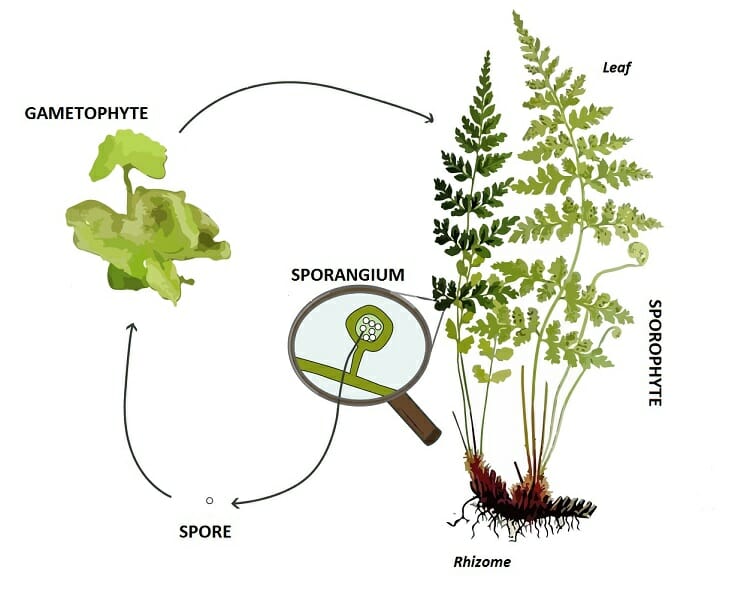
Then, when the sporophyte reaches maturity, a key point in the alternation of generations takes place. The sporophyte develops organs, known as sporangia. These specialized reproductive organs are used to create single-celled, haploid spores. These cells will be released into the air or water and carried away. When they reach a suitable environment, they will begin the process of developing into the gametophyte.


Gametophyte


This represents the next generation in the alternation of generations, as the haploid spore is created. The spore is technically a new organism, and has only half the DNA as the parent organism. This spore will undergo successive rounds of mitosis to form a new multicellular individual, the gametophyte. Where the sporophyte generation creates spores, the gametophyte generation creates gametes. Gametes are produced by special organs on the gametophyte, the gametangia. These gametes are then broadcast into the environment, or transferred between plants.


When they find an opposite gamete, they begin the process of fusing to form another zygote. This zygote will eventually become a sporophyte, and the alternation of generations will keep turning. While this is a simplistic version of the alternation of generations, there are many complexities, which will be discussed below. Because of these complexities, and because all plants undergo some version of alternation of generations, scientists prefer to refer to other aspects of their reproductive cycles to define the species.


The simplest form of alternations of generations is found in the fern, as seen below. As seen in the diagram, the gametophyte and sporophyte are clearly different individuals. This is not always the case.


Pteridophyte lifecycle


Complications with Alternation of Generations


Gendered Gametes


There are many additional factors which can complicate this basic theme of alternation of generations. The most notable complication is gender. Both sporophytes and gametophytes can have genders. Further, the sporophyte or gametophyte may not be totally independent of the other generation. Consider flowering plants for example. Some flowers have both male and female gametophytes housed within. In other flower species, the male and female flowers are separated, but may be present on the same plant. In still other flowers, individual sporophytes only give rise to a certain gender of flower.


The terms monoicous and dioicous are used to describe the gametophytes. If both genders are housed on the same individual, the species is monoicous. If they are separated, the alternation of generations is dioicous. This applies only to the gametophyte.


In the sporophyte, the terms used are monoecious and dioecious. Here, these describe whether the sporophyte will produce both genders, or if the genders are separated into different sporophytes. It is important to note that many plants are monoecious, but dioicous. This means that a single sporophyte can produce both male and female flowers. Many other combinations of these differences in the alternation of generations can be observed in various plant and algae species.


Differences in the Sporophyte and Gametophyte


During the alternation of generations in some species, there is an unequal distribution in size or dominance of either the sporophyte or the gametophyte. In different species, this can be reversed. In liverworts the gametophyte is the dominant generation. Liverwort is a gametophytic plant. In ferns, the opposite is true and the sporophyte is the larger, more dominant individual. This would be called a sporophytic plant.


In other species, the size and shape of the sporophyte and gametophyte is nearly indistinguishable. The only difference is the amount of DNA they carry and whether they will produce spores or gametes. While this may seem like they aren’t really doing anything, alternation of generations still allows sexual reproduction to occur. This greatly mixes the genes and increases the adaptability of the species.


Sporophytes and gametophytes from different species also produce different types of spores and gametes. If the gametes are the same, it is called isogamy. Some species of green algae produce only one type of gamete. These are both flagellated and swim in open water until they find each other. This scheme is not particularly useful for terrestrial plants. Most terrestrial plants show anisogamy, or a difference in their gametes. This is most commonly seen as the difference between the mobile male gamete and the larger, immobile female gamete, or sperm and oocytes. Other times, it is seen as a size difference only.


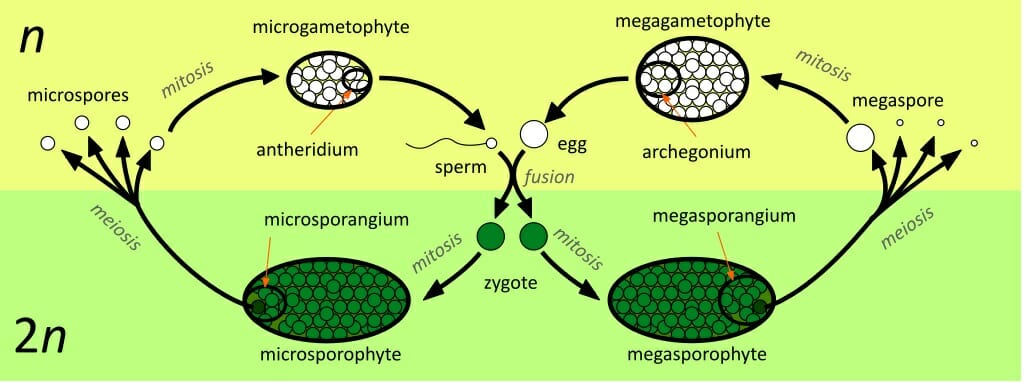
Below is a graphic representation of a dioicous, dioecious, anisogametic plant. This means that the plant has separate individuals of both gametophytes and sporophytes, and that the gametes it produces are of different sizes. This would be true of a holly or willow tree, which produces separate male and female flowers, on separate individual sporophytes.


Alternation of generations complex


Evolution of the Alternation of Generations


Fossil evidence, and the existence of many algae with simplified alternation of generation life cycles, hints that the evolutionary advantage of sexual reproduction through the alternation of generations is what made terrestrial plants adaptable enough to colonize the land. The alternation of generations allows for both the dynamic and volatile act of sexual reproduction and the steady and consistent act of asexual reproduction.


When the sporophyte creates spores, the cells undergo meiosis, which allows the gametophyte generation to recombine the genetics present. This allows for great diversity to arise. As plants colonized the land, they were initially isomorphic, or both the gametophytes and sporophytes looked and acted about the same. As time progressed, most plants found it beneficial to reduce one of these life cycles. Most flowering plants now have a much reduced gametophyte life cycle, while liverworts and mosses went the other way, preferring to diminish the sporophyte cycle. In the wide variety of plants alive today there is almost every variation of the alternation of generations conceivable.


Quiz


1. What is one advantage of the alteration of generations over an asexual species?
A. Asexual species have very little genetic recombination
B. There are no advantages
C. It is easier to reproduce

Answer to Question #1

2. What is the difference between the alternation of generations seen in plants and the sexual reproduction seen in mammals?
A. Mammals only alternate every other generation
B. Mammals do not alternate generations
C. Mammals produce sperm and eggs, where plants do not

Answer to Question #2

3. Is it better to have a more dominant sporophyte or a more dominant gametophyte?
A. Sporophyte
B. Gametophyte
C. Neither!

Answer to Question #3

References


  • Brusca, R. C., & Brusca, G. J. (2003). Invertebrates. Sunderland, MA: Sinauer Associates, Inc.

  • Hartwell, L. H., Hood, L., Goldberg, M. L., Reynolds, A. E., & Silver, L. M. (2011).Genetics: From Genes to Genomes. Boston: McGraw Hill.

  • McMahon, M. J., Kofranek, A. M., & Rubatzky, V. E. (2011). Plant Science: Growth, Development, and Utilization of Cultivated Plants (5th ed.). Boston: Prentince Hall.


Alternation of Generations

Monday, May 14, 2018

Tree Bark

What is Tree Bark?


Bark, often “tree bark” in botany, means the outer covering of woody plants. Woody plants, unlike herbaceous plants, create an intricate framework of cells and fibers, which provides significant support and protection. Bark is the woody exterior of this structure. Technically speaking, bark is not necessarily a scientific term. Bark is considered an accumulation of several different outer layers of a wood plant. It consists of tissues outside the vascular cambium, or central bundle of vascular cells. These tissues, unlike bark, are fully alive and transfer fluids from the roots to the leaves.


Function of Tree Bark


Bark, which includes everything towards the outside of the plant starting at the vascular cambium, is much thicker than most people assume. The inner bark is composed of living tissues, which help translocate the sugars created in the leaves to other parts of the plant. This happens in the secondary phloem. Outside of the secondary phloem, cells began to die off, and the layers begin to compress. These layers are responsible for providing protection. The outermost layer, the periderm, consists of several layers of more compressed cells. Some of these are cork cells, which are covered in a special type of wax and don’t collapse when they die.


Trees use their outer bark for different purposes, but mainly for protection against water loss and predators. Insects and herbivores want to eat the leaves off woody plants. These plants are often protected by thick bark past where local herbivores can reach. The outer bark, which the compressed cork layers, is also waterproof. This helps keep the inner bark from drying out, and insures the plant can continue to move sugars from the leaves to where they are needed.


Structure of Tree Bark


As woody plants grow, they grow by adding cells to the internal layers. As the layers are pushed outward, they compress and the cells die. Bark forms as part of this process, and is sometimes considered the entire outside of the vascular cambium. The vascular cambium is the main growth layer in woody plants. As it adds layers to the inside ring of the vascular cambium, the outside is pushed outward. The cells die off, and the fibrous matrix of cellulose and lignin molecules remain. This hard structure forms the bark, and protects the tree or plant from many forms of damage.


While bark is sometimes recognized as all tissues outside vascular cambium, others identify the rhytidome as bark. The rhytidome is only the outermost layer of the plant. If you were to peel back a part of the tree, the rhytidome would come off first. This is what most non-scientists would call bark. However, the cells below this will eventually become bark, and anatomically there is not much of a difference. The rhytidome, however, is completely dead. Scientist have thus termed rhytidome the outer bark, while the secondary phloem and secondary cortex are considered inner bark, because they still have living cells and function in metabolite transport. Remember that all of these layers lay outside of the vascular cambium.


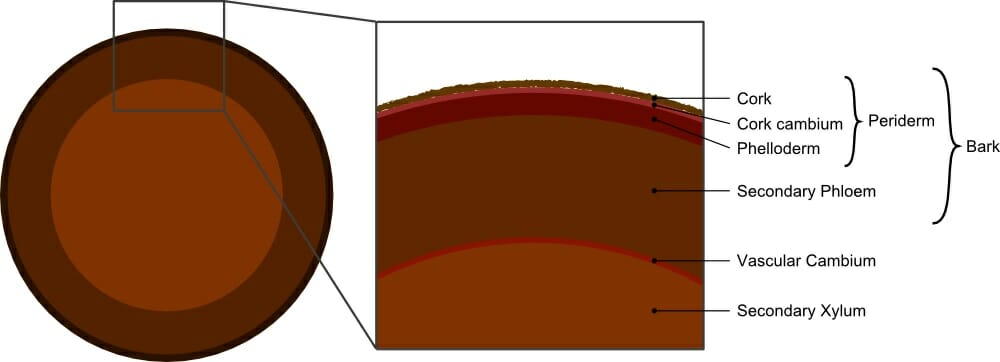
The following image shows only the living tissues in a woody plant, which excludes the outermost rhytidome layer. As seen below, the periderm is also a part of the bark, and has further divisions within which represent distinct layers. These layers provide a barrier against bacteria, insects, and keep the water and nutrients from leaching out of the plant.


Tree secondary components diagram


Bark is thickest at the trunk of plant. This is not only where plants are the oldest, but also where they can receive the most damage from herbivores, predators of plants. In fact, bark consists of 10-20% of the weight of most woody plants. The bark not only resists damage from animals, but it also prevents desiccation, disease, and provides a resistance to extreme temperatures.


Uses of Tree Bark


There are many commercial uses for bark, and it is often stripped away from the heartwood to be processed. The dead outer bark can be used to make shingles and siding. The outer bark is also known as cork, and can be ground to make cork products like corkboard, cork flooring, and even specialty items like yoga mats. Throughout history, bark has been used to make everything from boats to shingles, as its waterproof nature remains until it disintegrates. Historically, the inner bark has even been used to create flour and make breads out of, though the nutritional capacity pales in comparison to normal cereals.


Some species of plants also accrue peculiar substances in their bark which are good for making spices, sunblock and insect repellent. The inner bark is an important commercial resource for resins, tannins, and even the precursors to products such as latex gloves. In agriculture, there is a technique in which the bark is stripped below ripening fruit. This allows the sugars to remain concentrated in the fruit, and gives a better harvest. This technique is known as girding, and is sometimes used to produce extraordinarily sized fruit. If a branch is girdled, and all but one fruit on that branch is picked, the plant will put all of the sugars and metabolites from the leaves on that branch into the one remaining fruit.


Quiz


1. Which of the following layers is NOT considered bark?
A. Vascular cambium
B. Secondary Phloem
C. Rhytidome

Answer to Question #1

2. Why is it not a good idea to strip all the bark off a tree?
A. The tree will dry out
B. The tree will grow too fast
C. The tree’s fruit will be too sweet

Answer to Question #2

3. Which of the following is a possible use for bark?
A. Water storage container
B. Filter
C. Source of living tree cells

Answer to Question #3

References


  • McMahon, M. J., Kofranek, A. M., & Rubatzky, V. E. (2011). Plant Science: Growth, Development, and Utilization of Cultivated Plants (5th ed.). Boston: Prentince Hall.


Tree Bark

Auxin

Auxin Definition


An auxin is a plant hormone derived from the amino acid tryptophan. An auxin may be one of many molecules, but all auxin molecules are involved in some sort of cellular regulation. Auxin molecules are one of five major types of plant hormone. The other major groups are the gibberellins, cytokinins, ethylene, and abscisic acid. Auxin was the first of these groups to be identified, and was chemically isolated in the 1930’s.


The most widespread auxin is indoleacetic acid, or simply IAA. IAA is an auxin which is very important in the growth and development of plant tissues. In studying auxin molecules, scientist have been able to recreate similar structures, called synthetic growth regulators. These “fake” auxins also stimulate growth in plants and have been used in many agricultural and commercial applications.


Auxin Function


The auxin group of hormones has a wide range of uses in a plant. Auxin molecules are found in all tissues in a plant. However, they tend to be concentrated in the meristems, growth centers which are at the forefront of growth. These centers release auxin molecules, which are then distributed towards the roots. In this way, the plant can coordinate its size, and the growth and development of different tissues based on the gradient of the auxin concentration.


Auxin affects many different cellular processes. At the molecular level, auxin molecules can affect cytoplasmic streaming, the movement of fluids within a cell, and even the activity of various enzymes. This gives auxin direct control over the growth, development, and proliferation of individual cells within the plant. The auxin gradient directly affects processes such as flower initiation, fruit development, and even tuber and bulb formation. Even on a daily basis, auxin levels affect processes such as phototropism, which allows the plant to follow the sun and gain the most energy. The auxin controls this process by concentrating in the side of the plant away from the sun. This causes changes in the cells, which bend the plant toward the light. This can be seen in the image below.


Phototropism Diagram


Another important feature which auxin gradients provide many plants is apical dominance. Apical dominance is formed when a single meristem is growing faster and more efficiently. Eventually, the auxin released from this meristem inhibits any new shoots from budding off below it. If the stem is cut off, many new shoot will erupt below the stem, as the auxin gradient has been disrupted and the system must create a new leading shoot. The auxin gradient, when established, determines how fast internodes grow, which determines the height of the plant. When discussing the function of the auxin molecules in a plant, it is almost easier to discuss the things they do not control.


Some scientist have even discussed the polar-auxin transport system as a plant-like take on a nervous system. The way the auxin molecules move from cell to cell is very similar to how a nerve signal is sent across an animal’s body. The auxin molecule affects various tissues, and is usually converted into another auxin. A “return signal” can then be generated. In this way, using the many different versions of auxin and the other plant hormones, a plant could have a feasibly robust nervous system for responding to external stimuli.


Auxin Structure


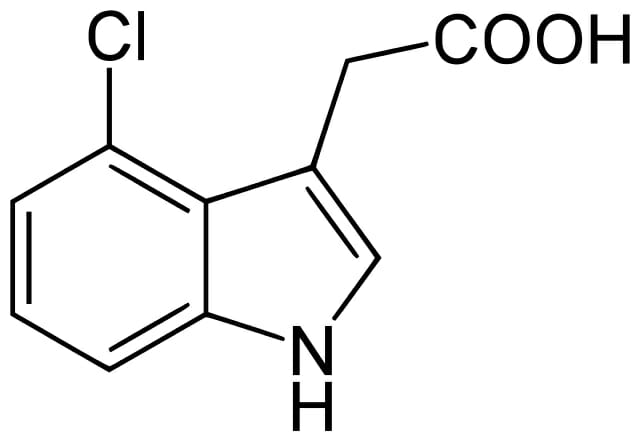
Native auxin molecules are normally derived from the amino acid tryptophan. This amino acid has a six-sided carbon ring, attached to a 5-sided ring containing carbon. This 5-sided ring has a group attached. The only difference between most auxin molecules and tryptophan is what is attached to this ring. The common auxin IAA can be seen below.


4-Chloroindole-3-acetic acid (4-Cl-IAA)


To create this molecule, two enzymes are needed to act on tryptophan. First, an amino-transferase removes a nitrogen and a hydrogen from the side-chain attached to the 5-sided ring. Then, a decarboxylase enzyme removes the carboxyl group, leaving only COOH. A chloride ion attaches to the six-sided ring, and IAA is born. Most auxins are some derivation of this molecule.


Synthetic Auxin Analogs


After studying the structure of natural auxin molecules, scientist were easily able to produce molecules which were similar to natural auxins. These synthetic auxin analogs have many applications. They can be used to encourage growth in certain plants. Synthetic auxin treatment is used on many plant cuttings, to induce rooting processes. In this way, scientist can make plant clones by taking cuttings, and growing the cuttings into entire plants.


1-Naphthaleneacetic acid (NAA) is a coming rooting chemical, and a synthetic auxin. This fake auxin is marketing to regular gardeners. While there are some safety and handling concerns, fake auxin molecules have been used since the 1940’s to stimulate the growth of cuttings. Scientist also found that auxin molecules could have anti-growth properties as well.


The synthetic auxin 2,4-D (2,4-Dichlorophenoxyacetic acid), is a common weed killer. The auxin-like molecule affects only broadleaf weed species. This means it can be applied around lawn, grassland, and other landscape plants without affecting them. However, in the broadleaf plants it causes rapid growth in all the wrong places. The plants quickly die off. There are many other synthetic auxin compounds, which have a variety of marketed uses.


Quiz


1. What is one risk of using synthetic auxin molecules?
A. They can make a plant grow too big
B. They are absolutely toxic to the end consumer
C. They can leach off, into the water supply

Answer to Question #1

2. A scientist takes three cuttings of an unknown plant. On one cutting, he puts no synthetic auxin. The second plant receives a light dose of auxin, while the last is soaked in a high dose. Which plant will develop the best roots?
A. Plant 2
B. Plant 3
C. Not enough info

Answer to Question #2

3. How is the animal nervous system different from the theoretical auxin-based nervous system described in this article?
A. Animal nervous system functions more efficiently
B. The animal system uses electrical impulses
C. Both nervous systems are the same

Answer to Question #3

References


  • Bruice, P. Y. (2011). Organic Chemistry (6th ed.). Boston: Prentice Hall.

  • McMahon, M. J., Kofranek, A. M., & Rubatzky, V. E. (2011). Plant Science: Growth, Development, and Utilization of Cultivated Plants (5th ed.). Boston: Prentince Hall.

  • Nelson, D. L., & Cox, M. M. (2008). Principles of Biochemistry. New York: W.H. Freeman and Company.


Auxin

Auxin

Auxin Definition


An auxin is a plant hormone derived from the amino acid tryptophan. An auxin may be one of many molecules, but all auxin molecules are involved in some sort of cellular regulation. Auxin molecules are one of five major types of plant hormone. The other major groups are the gibberellins, cytokinins, ethylene, and abscisic acid. Auxin was the first of these groups to be identified, and was chemically isolated in the 1930’s.


The most widespread auxin is indoleacetic acid, or simply IAA. IAA is an auxin which is very important in the growth and development of plant tissues. In studying auxin molecules, scientist have been able to recreate similar structures, called synthetic growth regulators. These “fake” auxins also stimulate growth in plants and have been used in many agricultural and commercial applications.


Auxin Function


The auxin group of hormones has a wide range of uses in a plant. Auxin molecules are found in all tissues in a plant. However, they tend to be concentrated in the meristems, growth centers which are at the forefront of growth. These centers release auxin molecules, which are then distributed towards the roots. In this way, the plant can coordinate its size, and the growth and development of different tissues based on the gradient of the auxin concentration.


Auxin affects many different cellular processes. At the molecular level, auxin molecules can affect cytoplasmic streaming, the movement of fluids within a cell, and even the activity of various enzymes. This gives auxin direct control over the growth, development, and proliferation of individual cells within the plant. The auxin gradient directly affects processes such as flower initiation, fruit development, and even tuber and bulb formation. Even on a daily basis, auxin levels affect processes such as phototropism, which allows the plant to follow the sun and gain the most energy. The auxin controls this process by concentrating in the side of the plant away from the sun. This causes changes in the cells, which bend the plant toward the light. This can be seen in the image below.


Phototropism Diagram


Another important feature which auxin gradients provide many plants is apical dominance. Apical dominance is formed when a single meristem is growing faster and more efficiently. Eventually, the auxin released from this meristem inhibits any new shoots from budding off below it. If the stem is cut off, many new shoot will erupt below the stem, as the auxin gradient has been disrupted and the system must create a new leading shoot. The auxin gradient, when established, determines how fast internodes grow, which determines the height of the plant. When discussing the function of the auxin molecules in a plant, it is almost easier to discuss the things they do not control.


Some scientist have even discussed the polar-auxin transport system as a plant-like take on a nervous system. The way the auxin molecules move from cell to cell is very similar to how a nerve signal is sent across an animal’s body. The auxin molecule affects various tissues, and is usually converted into another auxin. A “return signal” can then be generated. In this way, using the many different versions of auxin and the other plant hormones, a plant could have a feasibly robust nervous system for responding to external stimuli.


Auxin Structure


Native auxin molecules are normally derived from the amino acid tryptophan. This amino acid has a six-sided carbon ring, attached to a 5-sided ring containing carbon. This 5-sided ring has a group attached. The only difference between most auxin molecules and tryptophan is what is attached to this ring. The common auxin IAA can be seen below.


4-Chloroindole-3-acetic acid (4-Cl-IAA)


To create this molecule, two enzymes are needed to act on tryptophan. First, an amino-transferase removes a nitrogen and a hydrogen from the side-chain attached to the 5-sided ring. Then, a decarboxylase enzyme removes the carboxyl group, leaving only COOH. A chloride ion attaches to the six-sided ring, and IAA is born. Most auxins are some derivation of this molecule.


Synthetic Auxin Analogs


After studying the structure of natural auxin molecules, scientist were easily able to produce molecules which were similar to natural auxins. These synthetic auxin analogs have many applications. They can be used to encourage growth in certain plants. Synthetic auxin treatment is used on many plant cuttings, to induce rooting processes. In this way, scientist can make plant clones by taking cuttings, and growing the cuttings into entire plants.


1-Naphthaleneacetic acid (NAA) is a coming rooting chemical, and a synthetic auxin. This fake auxin is marketing to regular gardeners. While there are some safety and handling concerns, fake auxin molecules have been used since the 1940’s to stimulate the growth of cuttings. Scientist also found that auxin molecules could have anti-growth properties as well.


The synthetic auxin 2,4-D (2,4-Dichlorophenoxyacetic acid), is a common weed killer. The auxin-like molecule affects only broadleaf weed species. This means it can be applied around lawn, grassland, and other landscape plants without affecting them. However, in the broadleaf plants it causes rapid growth in all the wrong places. The plants quickly die off. There are many other synthetic auxin compounds, which have a variety of marketed uses.


Quiz


1. What is one risk of using synthetic auxin molecules?
A. They can make a plant grow too big
B. They are absolutely toxic to the end consumer
C. They can leach off, into the water supply

Answer to Question #1

2. A scientist takes three cuttings of an unknown plant. On one cutting, he puts no synthetic auxin. The second plant receives a light dose of auxin, while the last is soaked in a high dose. Which plant will develop the best roots?
A. Plant 2
B. Plant 3
C. Not enough info

Answer to Question #2

3. How is the animal nervous system different from the theoretical auxin-based nervous system described in this article?
A. Animal nervous system functions more efficiently
B. The animal system uses electrical impulses
C. Both nervous systems are the same

Answer to Question #3

References


  • Bruice, P. Y. (2011). Organic Chemistry (6th ed.). Boston: Prentice Hall.

  • McMahon, M. J., Kofranek, A. M., & Rubatzky, V. E. (2011). Plant Science: Growth, Development, and Utilization of Cultivated Plants (5th ed.). Boston: Prentince Hall.

  • Nelson, D. L., & Cox, M. M. (2008). Principles of Biochemistry. New York: W.H. Freeman and Company.


Auxin

Mesentery

Mesentery Definition


The mesentery is an organ which surrounds the organs of the gut, and suspends them from the abdominal wall. The mesentery is made of mesoderm cells, the middle of the three embryonic layers. This layer ends up surrounding all internal organs, as the peritoneum. In the gut, this layer folds over on itself and provides points of attachment for the other internal organs. The mesentery used to be known as a variety of different tissues related to the mesocolon. However, recent studies have revealed the mesentery to be a single organ, which suspends the internal organs in the abdominal cavity, and allows the various vessels of the body to reach these organs.


Mesentery Anatomy


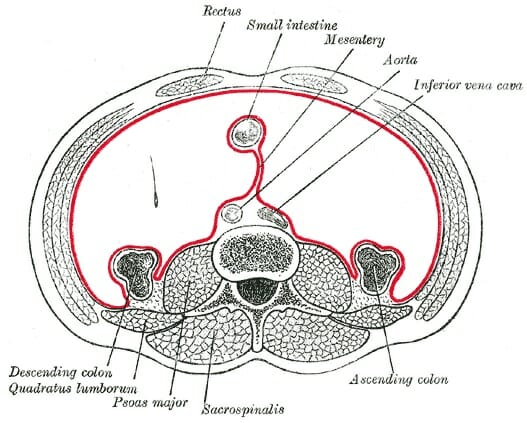
The mesentery, for many decades, was often not considered an organ because of its thin and convoluted nature. The mesentery surrounds all of the organs in the abdomen. Because it is formed during embryogenesis, the mesentery ends up getting twisted and turned as the gut develops. Therefore, the mesentery is a complex shape which surrounds the organs. The organ consists of sheet of tissue, which surrounds organs and folds back on itself. This can be seen in the image below. The mesentery is red.


Horizontal disposition of the peritoneum in the lower part of the abdomen


Notice how the mesentery surrounds the small intestine. The mesentery is very thin. Not shown in this picture are the many blood and lymph vessels which traverse the mesentery on their way to the intestines. On a microscopic level, the mesentery is similar to other connective tissues. It is comprised of several layers of cells, derived from mesoderm, attached to a matrix of connective fibers. The extracellular matrix of the cells allows for the creation of a very strong cell and fiber network, which can heal itself if damaged. Within this structure, blood and lymph vessels can carry their respective fluids to the intestines.


Function of Mesentery


Recent studies have shown that within these folds of tissue are complex arrays of lymph vessels, blood vessels, and immune cells. This suggests that the mesentery functions as a complex organ which carries nutrients away from the intestines while at the same time protecting from infection. The intestines are busy digesting food. As it travels through the intestine, nutrients are released and get absorbed by the cells of the intestine. These nutrients are transported to the blood, where they can be distributed to the body. The mesentery provides a stable and secure route for these vessels to pass. Without the mesentery, the fragile vessels would be subject to the pulling and stretching the body goes through.


The mesentery also allows lymph vessels to reach the intestines. This is important because nutrients are not the only thing that makes it through the intestines. Often, bacteria and viruses manage to squeeze their way through the intestines. The second line of defense is the immune system. White blood cells can defend the body and create antibodies to target the invaders. However, they must be able to reach the invaders. The mesentery gives the immune system access to this area of the body, even though it is contained within a cavity.


Besides these functions of directing and protecting vessels, the mesentery has an important role in development and support of the gut. During development, the expansions and contractions of the mesentery direct the shape of the gut. The colon, for instance, is pulled into place against the abdominal wall when the mesentery connecting the two shrinks in size. In fact, without the mesentery your organs would fall into a puddle in the bottom of your gut. The complex folds and attachment points hold your organs in place. They will even work when you are hanging upside-down or doing a backflip!


Still further research into the mesentery must be done. It has also been found to be a holder or excess fat, and is riddled with nerves stretching to the intestines and other organs. The mesentery is likely to have other, undiscovered functions which will be uncovered with time. Among these are likely to be immune defenses for the body and roles in development.


Mesentery and Disease


Along those lines, research has begun to show the prominent role the mesentery plays in several diseases. Because it is a line of defense from the digestive system, it is not surprising to find out that it is heavily involved in the defense against food-borne illnesses. More interesting however, is its function in the spread of other diseases, such as cancer.


Some studies coming out in recent years have shown that the mesentery may by an important pathway for metastasizing cancer cells to travel. These cells often travel through the lymph or blood vessels. Because the mesentery is lined so prolifically with them, it can become a central highway for distributing the cells. This may feature prominently in future cancer treatments.


Other diseases, such as Crohn’s disease, are caused by a malfunctioning mesentery. People with Crohn’s disease often have a swollen or hardened mesentery. This makes it difficult for the vessels contained in the mesentery to function properly. People with this condition often have a hard time digesting food, and can have compromised immune systems.


Quiz


1. Which of the following is NOT part of the mesentery?
A. The peritoneum around the heart
B. The peritoneum around the appendix
C. The peritoneum around the colon

Answer to Question #1

2. Which of the following is NOT a function of the mesentery?
A. Digestion
B. Support
C. Access for vessels

Answer to Question #2

3. A lancelet is a very small fish-like creature. It is one of the smallest organism with a notochord. The lancelet does not have a mesentery. Why could this be?
A. The mesentery is only in complex organisms
B. The mesentery is only needed to distribute nutrients
C. No structural support or access to the intestines are needed in lancelets

Answer to Question #3

References


  • De luliis, G., & Pulera, D. (2007). The Dissection of Vertebrates. Amsterdam: Academic Press.

  • Feldhamer, G. A., Drickamer, L. C., Vessey, S. H., Merritt, J. F., & Krajewski, C. (2007). Mammology: Adaptation, Diversity, Ecology (3rd ed.). Baltimore: The Johns Hopkins University Press.

  • Widmaier, E. P., Raff, H., & Strang, K. T. (2008). Vander’s Human Physiology: The Mechanisms of Body Function (11th ed.). Boston: McGraw-Hill Higher Education.


Mesentery

Creatine Kinase

What is Creatine Kinase?


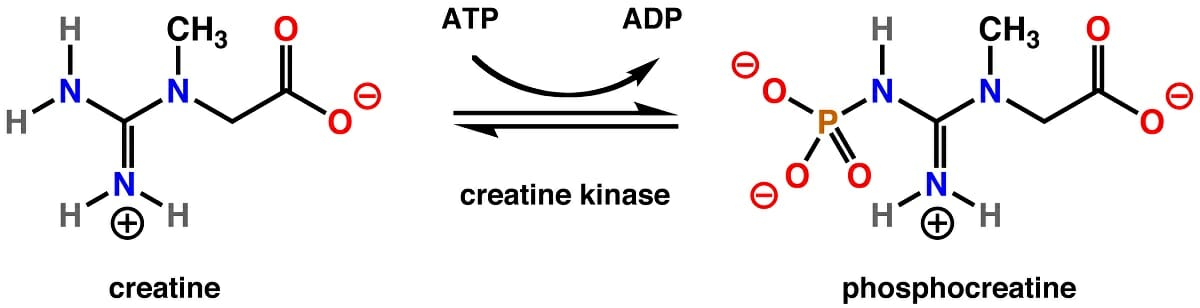
Creatine phosphokinase, or simply creatine kinase, is an enzyme found in many tissues which helps regulate the concentration of ATP (adenosine triphosphate) within a cell. In cells which need a lot of ATP, it is more economical to the cell to store the ATP as a less reactive molecule until it is needed. Thus, the phosphate group is transferred from ATP by creatine kinase to a creatine molecule. The end products are ADP (adenosine diphosphate), and PCr (phosphocreatine). This reaction is reversible, and when ATP is needed, it can easily be regenerated by the enzyme from the stored pool of PCr.


Function of Creatine Kinase


Creatine Kinase is found primarily in tissues which require a lot of ATP. Muscle cells, nerve cells, and even sperm cells are examples of highly active cells which contain large amounts of creatine kinase. This is because these cells must use a large amount of ATP to complete their work. Because of the nature of ATP, it must remain at certain concentrations to preserve the function of certain biochemical pathways. Therefore, the energy of ATP must be held in another place until it is needed. This place is PCr, which is simply a creatine molecule attached to a phosphate group.


The energy held in this bond can be efficiently and quickly converted by creatine kinase either to or from ATP. When there is too much ATP, creatine kinase functions to lower the concentration by converting ATP to ADP. It stores the extra phosphate on a creatine molecule, creating PCr. The pool of PCr in the cell is much larger than the amount of ATP. For this reason, it is considered a “fuel tank” or energy storage and utility system. As the mitochondria produce ATP through oxidative phosphorylation, the energy is transferred to PCr molecules, which are distributed to the cell.


These molecules do not affect the concentration of ATP, and therefore don’t interfere with cellular process. Other creatine kinase enzymes, which are attached to protein that require the energy from ATP, will use the pool of PCr to power whatever it is that they do. In this way, the production of ATP and the use of ATP are not directly tied to one another. The cell will usually only use high levels of ATP for a short amount of time, after which the system must return to normal. Using creatine kinase to maintain the “energy reservoir” is an efficient way to save up the ATP produced, without creating disruptive conditions for the cell. This is known as the PCr circuit. The chemical equation of the effects of creatine kinase can be seen below.


Creatine kinase


Structure of Creatine Kinase


Creatine kinase, like all proteins, is a specific chain of amino acids. When folded properly, this chain takes on a three-dimensional form, which gives it the ability to interact with certain molecules. The amino acids in creatine kinase are specific in that, when folded, they increase the interaction ability of creatine kinase with both creatine and phosphocreatine (PCr). Because the enzyme has a specificity for these molecules, it binds to them preferably over other molecules. Another site on creatine kinase is dedicated for interaction with ATP and ADP. As both molecules attach to the enzyme, it will either take a phosphate group from ATP and add it to creatine, or take a phosphate group from PCr and transfer it to ADP. The end result is either the creation or usage of ATP.


There are multiple types of creatine kinase, coded by different genes. While these forms of creatine kinase differ in their amino acid structure, their function remains similar. However, slight subtleties in function allow the creatine kinase to operate in different environments. For instance, mitochondrial creatine kinase, responsible for turning the ATP generated in the mitochondria into PCr for addition to the reservoir, must operate at different conditions than the creatine kinase in the cytosol. The pH balance and composition of solution are very different in the two areas of the cell.


Different cells even have different versions of creatine kinase, likely based on their function. The brain has a different form of creatine kinase than skeletal muscle. Smooth muscle and heart tissue use a combination of both types of creatine kinase. The different forms of creatine kinase all perform the same function, but under different conditions. These different forms are necessary to manage the energy reservoir in many different types of cell. In most cells, this reservoir of PCr is maintained at a concentration much higher than that of ATP. This makes it possible to do a lot of work.


Creatine Kinase Test


The different forms of creatine kinase make it a useful diagnostic took. Like other enzymes, creatine kinase is leaked into the bloodstream when a cell becomes damaged. If many cells are damaged at the same time, a detectable level of creatine kinase and other enzymes can be detected in the blood. Doctors can determine which form of creatine kinase is in the blood, which can give them clues as to which organs are being damaged.


A serum creatine kinase test can detect many conditions, such as a heart attack, muscle breakdown, and even autoimmune diseases which are attacking certain organs and tissues. After a heart attack, for instance, the creatine kinase level rapidly spikes in the blood. Further, a doctor can determine that it is a combination of muscular and brain creatine kinase. This is evidence that the heart has been damaged. Because the enzyme rapidly disappears from the blood, it can be used as an indicator to determine when a damaging event happened in the system. This can help find the cause of major events.


Quiz


1. A man enters the hospital with mild chest pain. The doctors test his blood serum, and find creatine kinase. Which of the following is a possible diagnosis?
A. Heart Attack
B. Indigestion
C. Lung irritation

Answer to Question #1

2. What would happen if you changed the amino acid structure of creatine kinase?
A. It would function worse
B. It would function better
C. It would change function

Answer to Question #2

3. Why does creatine kinase keep PCr at higher levels than ATP?
A. PCr is like the energy reservoir molecule
B. The opposite is true
C. PCr can be used directly by enzymes for energy

Answer to Question #3

References


  • Bruice, P. Y. (2011). Organic Chemistry (6th ed.). Boston: Prentice Hall.

  • Nelson, D. L., & Cox, M. M. (2008). Principles of Biochemistry. New York: W.H. Freeman and Company.

  • Widmaier, E. P., Raff, H., & Strang, K. T. (2008). Vander’s Human Physiology: The Mechanisms of Body Function (11th ed.). Boston: McGraw-Hill Higher Education.


Creatine Kinase