Sunday, April 8, 2018

Mass Spectrometry

Mass Spectrometry Definition


Mass spectrometry is a laboratory technique used to analyze the molecular composition of a sample. Mass spectrometry starts by vaporizing and ionizing the sample, most often using heat and a beam of electrons. The sample is then accelerated through a magnetic field, where its path is curved. Small particles bend more along the path. Once they reach the detector, they can be analyzed according to their mass to charge ratio. The computer attached to the detector will print a graph, showing which species were most abundant, along with their mass to charge (m/z) ratio.


This method is used in many different fields to analyze unknown substances. The data received can be used to determine the formula and structure of many different substances. High resolution mass spectrometry, which contains the most advanced ionization and detection equipment, can accurately determine the formula and structure of almost any compound. Mass spectrometry is used not only in sciences such as chemistry and biology to identify substances, but also in criminal forensics, to identify almost any substance encountered.


How Mass Spectrometry Works


Ionization of the Sample


The first process of mass spectrometry is ionization. Molecules tend to be hard to work with, unless they are charged. Charged molecules can easily be manipulated using electric and magnetic fields. To create ions, the substance must first be vaporized. A mass spectrometer will contain a chamber in which the sample is placed. This chamber will be heated, until a vapor is created of the sample.


This vapor will move through an electric field, through which electrons are passing. These electrons will knock electrons off of the molecules being analyzed. Alternatively, the sample could be chemically induced to create ions. Sometimes, the removal and redistribution of electrons causes different species of the molecule to form, which are fractions of the original molecule. These will be seen on the final output from mass spectrometry, and give vital clues to the structure of a molecule. This ionic vapor is now ready to be accelerated and analyzed.


Sorting the Ions


The ions are accelerated between two negative plates. This means that only positive cations can be detected. The negative species are removed via a vacuum pump. The positive ions travel down a curved tube. To bend the path of the ions, a large electromagnet encircles the tube. The voltage to this magnet can be adjusted, which will increase or decrease its overall strength. At the end of the tube is a small slit, through which molecules can exit and be detected by a sensitive screen.


Because the magnet can be adjusted, the computer controlling the unit will cycle through different power levels. The slit is small, and the power must be exactly right to get a particle to curve just right and exit the slit. Larger molecules will tend to curve less than small molecules. The computer graphs the output at each level, which corresponds the mass to charge ratio of the molecules at each level. In other words, only molecules of a certain size and charge can get through the slit at any given level of power. As this is adjusted, the computer can sense the total amount of molecules which make it through the slit. This allows the operator to effectively sort and analyze the entirety of any sample by processing it through mass spectroscopy. However, because the molecules must be ionized, there are also fractional species produced. This can aid in identifying the structure of the molecule, but it can also make identification vastly more complicated.


Detecting the Ions


The sensitive screen on the other side of the silt is bombarded with molecules. The computer analyzing this screen tracks their relative abundance at each mass to charge ratio. It will display the results as a graph, similar to the one below of carbon dioxide.


Carbon Dioxide Mass Spectrum


Note that the most abundant species is the carbon dioxide cation, or molecular ion. This is a radical ion created by the loss of 1 electron from the original carbon dioxide. The smaller peaks represent the other fragments of the molecule which are created during the analysis. You can see the peaks for carbon monoxide, oxygen, and carbon cations. These correspond to their molecular weights, and the strength of the bonds in the original molecule determine how easily fragments are created and how abundant they will be.


How to Read Mass Spectrometry


Mass spectrometry is analyzed by studying the graph created by the mass spectrometer. The machine will produce a graph with several bars. The tallest bar will reach the top of the graph. This was the most abundant species, and everything else is compared in abundance to this main species. The mass to charge ratio of this species can roughly tell you the molecular weight of the original molecule.


The peaks can tell you a lot about the molecule. The base peak is the most abundant and also represents the most stable species formed after the sample is ionized. Take for instance, the following analysis of the mass spectrometry of hexanal. You can see the chemical structure of this molecule imposed on the graph of mass to charge ratio versus abundance below.
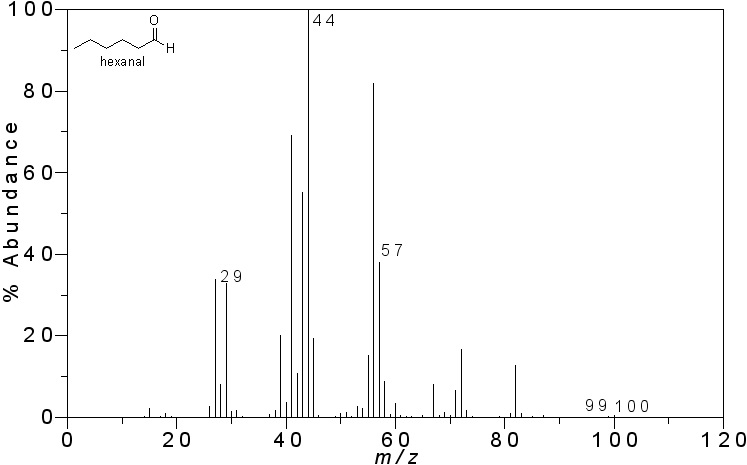

Hexanal


Notice first the base peak, at 44 m/z. This means that a species is formed when this molecule ionizes which has the mass of about 44 atomic units. The highest bar created is at 100 units. This represents the most complete version of the molecule, telling us the weight of the entire molecule. If we add all the molecules in hexanal (C6H12O), we will find it does indeed have an atomic mass of 100.


The peak at 44 represents a fraction of the molecule created by the oxygen, two carbons, and two of the hydrogens. The peak at 57 represents a larger portion of the carbons attached. The strong electronegativity of the oxygen double bonded to the carbon makes it a highly stable species, making it the most relatively abundant ion. All of these clues in the graph can lead us to the conclusion that our sample contained hexanal.


Quiz


1. Why do only positive ions make it to the detector?
A. The accelerator plates are negative
B. The magnet only affects positive ions
C. The ionization process only creates positive ions

Answer to Question #1

2. What is the purpose of the magnet in mass spectrometry?
A. The magnet affects the charge, bending molecule’s path according to weight
B. The magnet pulls metal fragments, purifying the sample
C. Only magnetic materials will be affected, allowing categorization

Answer to Question #2

3. Why is mass spectrometry useful in criminal forensics?
A. Forensic scientists don’t use mass spectrometry
B. It can be used to identify almost any unknown substance
C. It can measure if bullets came from the same gun

Answer to Question #3

References


  • Bruice, P. Y. (2011). Organic Chemistry (6th ed.). Boston: Prentice Hall.

  • Moore, J. T. (2010). Chemistry Essentials for Dummies. Indianapolis: Wiley Publishing, Inc.

  • Nelson, D. L., & Cox, M. M. (2008). Principles of Biochemistry. New York: W.H. Freeman and Company.


Mass Spectrometry

Chromatography

Chromatography Definition


Chromatography is a method of separating the constituents of a solution, based on one or more of its chemical properties. This could be charge, polarity, or a combination of these traits and pH balance. In essence, the solution is passed through a medium which will hinder the movement of some particles more than others. This draws the different molecules apart as they travel through the medium. Oftentimes, different dyes are used to represent the different parts, or fractions of the media.


There are many different types of chromatography, used in a variety of circumstances. While the following is not a definitive list, it is a good overview of the different types and uses of chromatography. As each is discussed, try to picture how it conforms to the broad definition of chromatography. The exact procedures may vary, depending on the circumstance, but all chromatography is centered on moving a solution through a media which slows certain molecules more than others.


Electrophoresis is similar to chromatography, in that a solution is moved through a media. However, in electrophoresis the DNA sample of multiple DNA fragments is dyed the same color. As it travels along the gel, propelled by the electric current, visible bands are seen which represent different sized segments of DNA. In chromatography, many more substances can be tested. The media can be changed, to better retain or expel certain substances, or the solution holding the substance can be altered to improve the separation.


What is Chromatography Used For?


Chromatography is used in many industries, for many purposes. In general, it is used to separate a desired substance from a solution. This could be a specific amino acid from a sample containing many, or a desired chemical from an unknown sample. Chromatography was originally named as it was used to sort plant pigments, which come in many different colors. The pigments sorted when places on a chromatography paper and a solvent allowed to travel with the pigments across the paper. The paper, made of cellulose and having a slightly negative charge, attracts polar substances. This allows the non-polar pigments to travel further, separating from the more polar pigments.


These techniques have expanded to many different industries, the basic principles remaining the same. Upon knowing the characteristics of the desired substance, a medium and solvent can be obtain which will interact with the substance and remove it from the solution. Using a solution with a different pH, or a different composition, the desired substance can then be washed off the media, and collected.


These principles are used to isolate and analyze enzymes, pigments, amino acids, constituents of DNA, and almost any other molecule you can imagine. All molecules have specific interaction with other molecules, and a chromatography experiment can be designed to retrieve almost any molecule from a seemingly homogenous solution.


How Does Chromatography Work?


The core of chromatography lies in the fact that the molecules being separated can move through the media at different speeds. This may be because they have a certain affinity towards the media, or simple because the media is sized to only allow certain molecules through. In some forms of chromatography, the media has such a strong affinity for the desired substance that it binds it as the original solution is poured over, and another solution containing a substance to displace the bound molecules must be introduced.


The affinity for the media could be from a number of properties. Some are designed to attract polar substances, and repel nonpolar substances as in the original chromatography experiment. However, the media could also be designed to hold onto specific ions, or could even be created with antibodies which identify and retain specific proteins. The possibilities of chromatography are nearly endless, but the basic principle of separating molecules by passing them through a selective filter remains the same.


Types of Chromatography


Column Chromatography


Column chromatography is a popular form of the technique, which relies on a solution filled column, filled with a media which will in some way inhibit the movement of particular molecules. As the solution is drained from the bottom, different fractions are obtained as the solution comes out. These fractions will contain different compositions of molecules, determined by how fast the molecules could travel through the column. In basic column chromatography, silicon beads or other negatively charged media are used as a simple way to sort molecules by charge and polarity.


There are several variations of column chromatography, which differ in their media and solvent. They are used to separate different substances from solution. For instance, if the media within the column is meant for ion-exchange chromatography, it will be somehow charged. As a solution passes over it, ions will attract to the media and be drawn from solution. A different solution can then be washed over the media, which will have a higher affinity for the media and displace the ions. They can be washed away and collected, purifying them from the original solution.


Planar Chromatography


Planar chromatography, which includes both the paper and thin-layer methods, depends on a solution moving through a media due to the forces of adhesion and cohesion. If you’ve ever seen a napkin soak up a mess, you’ve seen these forces. As the dry gaps in the material are filled, the solution crawls its way up the napkin. In the same way, planar chromatography uses these forces to pull molecules through a media.


In the same way that gravity forces the solution over the media in column chromatography, adhesion and cohesion pull the solution through the media. In this case, the media is very thin. In paper chromatography, the paper is usually cellulose-based, which is slightly negative. This makes the sorting of polar and nonpolar substances very easy. In thin-layer chromatography, the layer can be made of any substance which has an affinity for the target substance. Solution is allowed to pass through or over it, and the substance is acquired from the solution.


Paper and thin-layer chromatography have been used to sort and identify pigments, amino acids, and many different kinds of organic molecules. Because it is so simple to set up a paper chromatography experiment, this is one of the first laboratory techniques presented in science courses.


Other Forms of Chromatography


Besides these common methods of the technique, there are many more. One, which is used in the more advanced sciences and in criminal forensics is gas chromatography. In gas chromatography, the substance to be sorted is vaporized, and passed through another gas containing various elements. Much like the other forms of chromatography, it is the affinity for particular molecules in the media which causes the separation of the solution.


Still other methods couple chromatography directly with mass spectrometry, a method of identifying the chemical and structural properties of molecules. This is a powerful method which can both separate and identify individual components of a complex solution. The machinery to do this is expensive and sensitive, but necessary for many scientific and forensic applications.


Quiz


1. You are trying to identify an unknown substance dissolved in a sample of pond water. What is the first step?
A. Use chromatography to remove the substance
B. Identify the substance using mass spectrometry
C. Hypothesize the nature of the substance

Answer to Question #1

2. A scientist places some mushed up plants at the base of a strip of cellulose-based media. He places this strip in a solvent, and the solvent travels up the strip. Which form of chromatography does this represent?
A. Gas
B. Column
C. Planar

Answer to Question #2

3. Which of the following represents a chromatography?
A. An artist allows multiple pigments to separate as they diffuse through the paper
B. A watermelon, being naturally red in the middle and green on the exterior
C. Two dyes are mixed together, allowing new colors to be created

Answer to Question #3

References


  • Bruice, P. Y. (2011). Organic Chemistry (6th ed.). Boston: Prentice Hall.

  • Moore, J. T. (2010). Chemistry Essentials for Dummies. Indianapolis: Wiley Publishing, Inc.

  • Nelson, D. L., & Cox, M. M. (2008). Principles of Biochemistry. New York: W.H. Freeman and Company.


Chromatography

Tuesday, April 3, 2018

Bogeyman


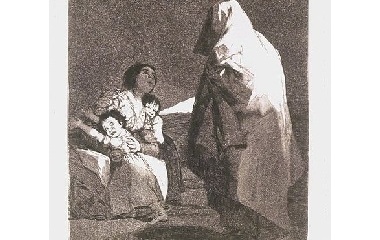
Around the world, millions of children are terrified each year by the idea of the Bogeyman (also spelled Boogeyman). Any bump in the night or scratch on their window pane sends them running in terror to their parents. The boogeyman terrifies children around the world into good behavior – or else.

Who is the Bogeyman?


The bogeyman is a mythical monster whose impact can be traced around the world. One of the first references to this legendary creature was found in the 1500’s, though it is suspected that the boogeyman has existed much longer than this.


It is thought that the boogeyman was originally a reference for mischievous creatures called hobgoblins. Throughout much of Europe, hobgoblins are actually quite friendly or limited to light-hearted pranks, but there are tales of hobgoblins who were much more vile in nature. These creatures were said to torment humans – sometimes to the point of frightening a person to death.


Regardless of how the bogeyman came to be, he exists as one of the most well known and feared creatures of all time. There are hundreds of names for the bogeyman around the world – each with their own interesting twist. Because the boogeyman has such a large global impact, it is difficult to determine which country told the first tales of this monster. One thing is for certain – the boogeyman loves to lurk in the shadows of the night and its main victims are disobedient children who don’t listen to their parents.


Characteristics


Physical Description


Descriptions of the bogeyman vary from country to country, though there are a few similarities. The majority of boogeymen are some sort of spirit or entity that terrorize naughty children in the night. The boogeyman could strike for any number of reasons – ranging from anger towards children who leave things dirty to hunger for children who stayed up past their bedtime.


Many boogeymen are said to have long nails or claws that they use to scratch against window panes in the middle of the night. There are also tales of bogeymen who have terrifying eyes that haunt children who venture outside after dark. Some boogeymen are said to have horns or look very animal-like, while others are told to be evil humanoids or witches.


In the United Kingdom, it is thought that the boogeyman could have originally been a description of a ‘buggy man’ like creature. The ‘buggy men’ were responsible for picking up the dead – especially when the black plague was devastating Europe. Because of their contact with the dead, they were often very sick themselves and had skeleton-like figures with sunken eyes.


Other boogeymen have no appearance are said to have no figure or the ability to shapeshift. They can appear as the tree limb scratching against your window, or simply present themselves as a terrifying shadow lurking underneath the bed.


Perhaps one of the most interesting features of the boogeyman is its ability to exist in the folklore of hundreds of countries while having very few physical similarities. The bogeyman’s ability to blend and adapt to many cultures leads many to think of the bogeyman as a type of spirit.


Personality


The bogeyman, while mysterious, is best understood through its motivations. The boogeyman is primarily fixated on children, though there are myths in some countries that suggest the boogeyman will seek out anyone who is guilty of wrong-doing. Regardless of what age group a particular boogeyman goes after, it seems to be a common theme that the boogeyman will not attack those who are considered to be ‘good.’


There are many variations on why the bogeyman preys on its victims. Most versions of the boogeyman will come after children if they’ve been naughty and disobeyed their parents in some way. These boogeymen have a wide range of punishments that they choose from. Some boogeymen will only give children terrifying reminders like scratching on their window panes at night, appearing as a shadow that lurks in their bedroom, or chasing them when they’ve wandered away from home in the middle of the night.


Other boogeymen are more sinister, making it even more important for children to mind their parent’s instructions. These bogeymen have a taste for naughty children and will often sneak into their rooms to carry them away into the night. These children are often never found and are said to be eaten by the bogeyman.


There is also a strange category of bogeymen who do not come after children simply for being naughty. These bogeymen often serve as a strange sort of protector even though they tend to have terrifying appearances. There are also boogeymen who don’t discriminate with the age of their target. They simply attack the guilty.


Bogeyman Around the World


Wewe Gombel


In the Semarang area of central Java, there lurks a bogeyman who strikes fear into the hearts of children and parents alike – the Wewe Gombel. This strange boogeyman is said to be a spirit that seeks both vengeance and acceptance. Although the Wewe Gombel spirit is evil in nature, it does not harm children. Instead, she kidnaps children that are being neglected or abused and hides them from their parents until she feels the parents have learned their lesson.


Even though she takes her vengeance out on the parents, she is feared by children as well for her strange habits. It is said that any child unfortunate enough to be kidnapped by the Wewe Gombel is forced to eat feces until they are allowed to return home.


El Coco


El Coco (also known as the Coco Man) is known to strike fear into the hearts of many Hispanic and Latino children. This strange beast is not known to have a specific appearance, but is instead thought to be a shapeshifter that is ‘terrible to look at.’ In some regions, the Coco Man is thought to have the power to transform into the thing a child fears most.


El Coco climbs onto the roofs of children who disobey their parents and waits until they fall asleep. It is then that El Coco sneaks into the room of the naughty child and kidnaps them for its next meal.


Babaroga


Babaroga is a Croatian boogeyman that has a deep hunger for disobedient children. This boogey is said to be an ugly old woman with horns atop her head. She stalks her prey at night and takes them back to her dark hiding place where she devours them.


Babaroga is thought to carry a bag that she uses to drag children away into her lair (which is often a cave). Sometimes she preys on children who venture out too late at night, while other times she is said to reach down through the cracks in the ceiling to grab her prey.


Tata Duende


Tata Duende comes to us from Latin America and is most prominent in Mayan and Mestizo folklore. This bogeyman has backwards feet and is missing his thumbs, which gives him an odd fixation on the thumbs of humans – especially human children.


It is said that the Tata Duende (which translates roughly to Grandfather Goblin) is the protector of the jungle. However, he can also be very mischievous at times. If Tata Duende finds a naughty child, he will lure them into the jungle and try to bite off their thumbs.


The Namahage


The Namahage is a Japanese demon who preys on children who are disobedient, lazy, or prone to crying. The Namahage is known to steal crops and disobedient children during the New Year. They are known to roam city streets during the night and calling out, “Are there any cry babies?”


L’uomo Nero


L’uomo Nero is typically portrayed as a man dressed in all black that haunts disobedient children in the Eastern Mediterranean area. The bogeyman is often said to also wear a hood or hat that hides his face. The L’uomo Nero comes to kidnap children who disobey their parents, though unlike other boogeymen he doesn’t eat them. Instead, he takes them to a frightening place to live with him for a year.


Oude Rode Ogen


Oude Rode Ogen (also known as ‘Old Red Eyes’) is thought to be a shapeshifting cannibal who preys on young children. It is thought that the form this beast was most likely to appear in was that of a black dog with red eyes.


The Night Hag


The night hag is an evil spirit thought to cause sleep paralysis and nightmares. This spirit is an old woman who preys on fear and nightmares of her victims. She sits on the chests of her victims while they sleep, causing them to have difficulty sleeping and enter into a disturbing dream state.


The Jumbie


The Jumbie is an evil human spirit that comes back to haunt the living in Caribbean folklore. While similar to ghosts, Jumbies differ in that they cast a dark black shadow instead of appearing as a wispy figure. These spirits are malevolent and will target anyone.


Real Life Bogeymen


Though many bogeymen are believed to be fictional characters created by parents who wanted to scare their children into behaving. However, there are a few accounts of bogeymen who turned out to be real, and perhaps more terrifying than any urban legend could have suggested.


Albert Fish


Hamilton Howard ‘Albert’ Fish was born on May 19, 1870 to an extremely dysfunctional family. His family had a history of mental illness, which many like to blame for his terrifying behavior.


Fish claims to have begun molesting young boys at the age of 20 and grew to incorporate sadist practices later on. As he aged, he also began assaulting young girls. He targeted children who were either intellectually handicapped or African American. He later claimed this was because he assumed they wouldn’t be missed.


He wasn’t caught until 1934 when he sent a letter to one of his victim’s parents. In it, he detailed the brutal killing of his victim (Grace Budd) and how he cut her into pieces in order to cannibalize her. After he was found and arrested by the police, he was confirmed to have murdered at least two other children, though he claimed to have murdered over 100 children before he was caught.


He is thought to be one of the most brutal serial killers in history.


Cropsey


The children of Staten Island are probably familiar with the legend of ‘Cropsey’, but it wasn’t until 1987 that the story was discovered to be real.


Cropsey was a well known bogeyman in the Staten Island area. In fact, he was so popular that parents often told the story of Cropsey to children at night before they went to bed to ensure that they didn’t try to sneak out a night.


Cropsey was supposedly a homicidal man who had escaped an insane asylum. He hunted for children at night and supposedly had a claw for a hand that he used to drag children back to the ruins of the old Seaview Hospital. On other occasions, he simply appeared while holding a bloody axe.


For years, this urban legend of the Staten Island boogeyman was thought to be nothing more than a tale, but in 1987 the real Cropsey emerged. Cropsey’s real name was found to be Andre Rand.


It was a shock that Rand wasn’t caught sooner. He had a history of violence toward children. In 1969 he was arrested for trying to sexually assault a young child. In 1983 he kidnapped a bus full of young children. Additionally, he was suspected in the disappearances of four children between 1972 and 1984.


Despite his record and local police suspicions, Rand wasn’t captured until 1987 when he kidnapped Jenifer Schweiger – a young girl with Down Syndrome. Her corpse was found in a grave outside of the Willowbrook State School (a school for the mentally challenged that Jenifer used to attend). Rand had been the janitor at this school despite his long history of violence towards children.


Explanation of the Myth


Though there are some that believe the bogeyman myths are inspired by real creatures, the majority of people believe that the bogeyman is nothing more than a tale told by parents who wanted to scare their children into behaving.


Bogeyman

Monday, April 2, 2018

Kappa


In the waters of Japan there lurks a creature that is as mysterious as it is terrifying – the Kappa. This strange creature is thought to hold magical powers that can be used for both good and evil. Unfortunately, the Kappa prefers to use its gifts to play tricks on humans or lash out violently towards them. Though many refuse to believe in the existence of the Kappa, there are still many sightings today – especially in the countryside of Japan. In fact, locals still hang warning signs near bodies of water thought to be frequented by the Kappa.


What is a Kappa


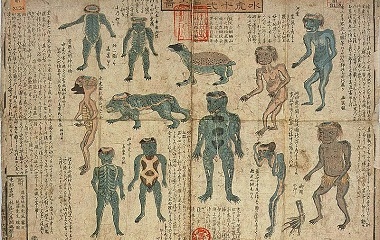
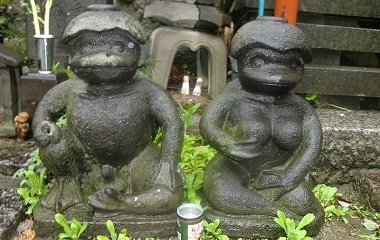
The Kappa is a mythological monster said to inhabit ponds and rivers in Japan. This strange creature is said to have the appearance of both a humanoid and reptile and are extremely cunning. Kappas have over 80 different names, though the most common are kawappa, gawappa, and kawaso.


Kappa considered to be a type of suijin (water deity) that inhabits the freshwater areas of Japan. According to legend, the Kappa is fond of causing mischief and even harm towards humans. A Kappa’s pranks can manifest in the form of harmless jokes like making noises similar to flatulence or looking up a woman’s kimono. However, some Kappa are more violent and have been known to try to drown livestock, kidnap and eat children, and force themselves upon women.


Although Kappa are generally considered a force to be feared, there are some instances in which the Kappa are considered to be generous – though this most often happens when a Kappa is indebted to a human being. Some of the most common records of friendly Kappa are early Japanese legends that attribute the knowledge of bone setting and medical salves as being taught to man by friendly Kappa.


Characteristics


Physical Descriptions


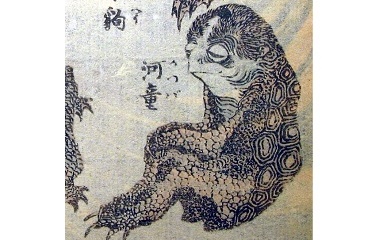
Descriptions of Kappa vary from region to region, but most of the details are similar. Kappa are said to be about the size of a small child (never more than 5 feet tall) and have relatively small frames. In fact, the word ‘Kappa’ actually translates roughly to ‘water child.’ Their hands and feet are webbed and they are said to have amazing swimming capabilities.


Kappa also have scaly skin, similar to that of a reptile. Their skin color varies, but is said to come in hues of yellow, green, and blue. Kappas are said to have a humanoid figure with the shell of a tortoise on its back. Additionally, most Kappa have long, shaggy hair that is usually shaped in a bowl cut. They also have a beak for a mouth, though this doesn’t seem to interfere with their abilities to speak in human languages.


Last but not least, all Kappa have a small bowl-like dent on top of their heads that holds a small pool of water called the ‘sara.’ This water is though to be the source of the Kappa’s magical powers. A Kappa must keep their sara full whenever they venture onto land or forfeit all their strength and magical powers. Without this water, a Kappa could possibly die. However, it is thought that if you refill the sara atop a Kappa’s head, they will be eternally grateful and will help you with whatever you require for the rest of your lifetime.


There are also reports of a type of hairy Kappa that are known as hyosube, which are thought to be hungry ogre-like monsters.


Personality


Kappas are considered to be malevolent creatures that have a tendency to direct their anger towards humans and livestock. Some Kappa are pranksters that like to make offensive jokes that people uncomfortable like making sounds similar to flatulence or looking up a woman’s kimono. Other Kappa are more violent and purposefully try to drown livestock and small children, drink the blood of victims, and sexually assault women.


According to lore, Kappa are obsessed with an object called shirikodama – a mysterious jewel thought to contain a person’s lifeforce that is located in the shiri (anus). It is thought that the majority of attacks by Kappa are made to obtain the shirikodama. However, Kappa do not always kill for the purpose of touching or obtaining a shirikodama. Many myths tell of Kappa lurking in toilets (which were usually situated over the river) and waiting for an opportunity to sexually assault women. It was not uncommon for these women to later give birth to Kappa children. Upon birth, these children were cut into pieces and buried in jars because of their hideous appearance.


However, despite their evil ways, Kappa are obsessed with politeness and human tradition. This is considered to be its biggest weakness. Many who tell of a Kappa encounter in which they escaped claim that they were able to do so because they made the Kappa spill the water in its sara when they bowed. Kappa are also considered to be extremely trustworthy and honest. If you refill the water in the sara of a Kappa, it will help you with whatever you require or make a promise for whatever you ask.


Kappa are also considered to be extremely knowledgeable creatures. They are known to speak human languages even though they have a beak for a mouth and hold great knowledge of medical practices. It is said that the ancient tribes that inhabited Japan were able to lean the art of bone setting and the creation of medical salves from friendly Kappa.


Powers


The powers of a Kappa are thought to be magical and are greatly respected by all those who believe in the deity. All Kappas are known to posses incredible strength and impressive swimming capabilities. They are also known for their love of fighting – especially sumo wrestling. It is said that a Kappa’s greatest joy in life is to engage in combat with its victims. However, many are able to escape its invitation to fight by making a deep bow to the Kappa. According to legend, Kappas are obsessed with politeness and will return the bow, spilling their water in the process.


Kappas are also known to be extremely intelligent. They are credited with bringing many medical practices to the ancients of Japan including the art of bone setting and creation of many medicinal salves. It is said that if you befriend a Kappa, it will grant you with the knowledge of many medicinal practices.


How to defeat a Kappa


There are thought to be several ways to defeat or fend off a Kappa. The most common method was to use its own obsession with politeness and human tradition against it. It is said that if you encounter a Kappa, you should bow deeply to it. The Kappa will feel obligated to return the bow and will spill the water in its sara in the process, rendering it powerless. Be careful however – some Kappa have caught onto this practice and use a metal plate to protect their sara when they come ashore.


When it comes to Kappa who use a plate to protect their sara, there are other ways to ensure that they do not harm you. It is said that a Kappa’s arms can be easily detached from their bodies. If you can sneak up on a Kappa or are fast enough to grab their arm during combat and pull it off, a Kappa will promise you anything in order to have it returned. Many Japanese legends speak of heroes who overcame Kappa with this strategy and were able to obtain safety for their entire village in exchange for the returned arm.


Other ways of dealing with Kappa can be found in their love of certain foods – especially cucumbers. It is thought that cucumbers are one of the few things Kappa love more than the internal organs of young children. Many people believed that writing the names and ages of everyone in their family on pieces of sliced cucumber and throwing them into the water before bathing would ensure that no one in their family would be harmed. There is also a debate on whether eating cucumber would ensure safe passage in water. Those in certain regions believe that this will serve as protection, while others consider it to make a Kappa attack inevitable.


There are also several accounts of people being able to ward off Kappa by carrying iron, sesame, or ginger on their person.


Related Characters


There are several creatures that appear in lore from other ancient cultures and are thought to be related to the Kappa. One such creature is the Nix – a shapeshifting man that can be found in Norse mythology. Nix were known as beautiful creatures that had the power to draw women and children to the water’s edge with their sweet melodies. Malevolent Nix were known to drown their victims, though there were kind Nix who meant people no harm. In fact, some of these friendly Nix were thought to have married human partners.


There are also accounts of Siyokoy in the Philippines that are very reminiscent of the Kappa. The Siyokoy are creatures that are humanoid in appearance with scaly green skin. They are also thought to have webbed hands and feet, similar to that of a Kappa. They are known to drown humans and eat them. They are commonly accompanied by creatures like eels, rays, and squid.


Explanation of the Myth


Urban Myth to Scare Children


There are many who would explain the legend of the Kappa as a simple story for children to scare them into behaving. One of the most common types of Kappa stories are focused on the creature’s fixation on disobedient children. It was thought that when disobedient children ventured too close to the water without their parents, the Kappa would pull them into the water and drown them. There are several variations as to what would happen next. Some stories simply state that the Kappa kidnapped the children, while others detailed that the Kappa would drink the blood of their victims or eat their internal organs.


It is thought that this tale of the Kappa helped to reduce the number of children who were lost to drownings or other misfortunes by ensuring that the children stayed with their parents and didn’t wander off into danger.


Otherworldly Creatures


There are also those who believe that the Kappa could be a type of alien creature that somehow found its way to Earth. Many who have faith in this argument also believe that other mythological sea creatures inhabit Earth in the uncharted areas of the sea.


Their argument? These strange sea aliens are able to travel to and from the Earth through portals – which may explain why we’ve never been able to prove their existence. They claim that these portals come in the form of mysterious whirlpools. Admittedly, whirlpools and strong water currents are one of the most common descriptions that arise in mythology speaking of the appearance of these strange creatures.


Additionally, many scholars point out that several ancient cultures speak of sea creatures who are documented to have ‘fallen from the sky.’ Many of these creatures, gods, and goddesses are also said to have immediately submerged themselves in a body of water as soon as they arrived and are also credited with teaching human beings religion, culture, and medicine.


Likewise, the early Kappa are known as friendly helpers who worked to teach humans important medical practices such as bone setting.


Leech Babies


There also some who theorize that Kappa stories originated as a way to keep children away from bodies of water to keep them from seeing ‘leech babies.’ Leech babies were either stillborn infants or newborns that were killed by poor families that couldn’t afford to care for them. These children were then thrown into rivers, lakes, and ponds – the same places said to be inhabited by the Kappa.


In the ancient world, it was very common to encounter a leech baby because of the high number of struggling families that simply couldn’t afford to take care of them. Whether the story of the Kappa was meant as a warning for what could become of disobedient children, or an explanation for the horrible sight that could have been terrifying to the young of ancient Japan, many are certain that leech babies are the root of the Kappa legends.


The Japanese Giant Salamander


Still others claim that the legend of the Kappa is no more than a fear of the Japanese giant salamander. These salamanders grow to be up to 5 feet in length and have skin tones similar to that of the Kappa. The Japanese giant salamander are also known for grabbing their prey with their strong jaws and pulling them into the water. Coincidentally, Japanese giant salamanders are also known to frequent the same areas as the Kappa – rivers, lakes, and ponds.


Kappa

Mendel"s Law of Heredity

Mendel’s laws of heredity refer to the Austrian monk Gregor Mendel who lived in the early 1800s. He conducted experiments crossing varied sizes and colors of pea plants which revolutionized the understanding of heredity. Taken together, his laws make up the principles of Mendelian inheritance.


At the time of his experiments, Mendel knew nothing about genes or chromosomes. But through his work he came to understand that garden peas transmit their visible traits (phenotypes) like color and height to their offspring in a measurable way. Also, Mendel found that through careful observation and record keeping, he could predict the color and height of pea plants.


Mendel’s First Law – The Law of Segregation


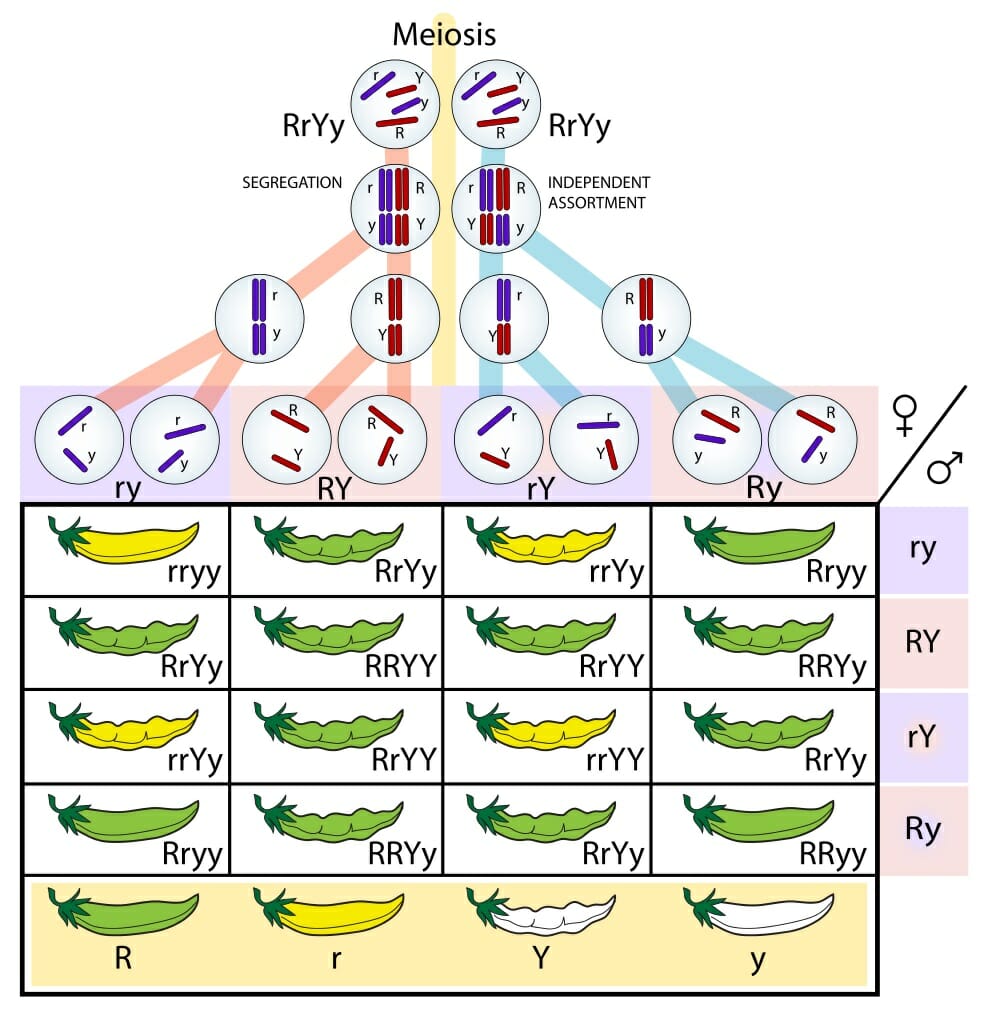
The law of segregation says parental genes for a trait must segregate (separate) equally and randomly into haploid gametes so that their offspring have an equal chance of inheriting either allele. This is what happens during meiosis. Offspring inherit one allele from each parent for a trait and no allele is favored or has an advantage over the others. Figure 1 shows the male and female pea gametes that resulted from segregation of the pod color and texture traits during meiosis.


Mendel’s Second Law – The Law of Independent Assortment


Mendel’s second law says that alleles for traits are passed on independently of each other. To put it another way, the selection of an allele for a trait has nothing to do with which allele is selected for a different trait. Mendel discovered this natural law while doing dihybrid cross experiments. Up to that point, he had been studying monohybrid crosses which examined just one trait in the pea plants like color or height. These crosses resulted in a 3:1 ratio between dominant and recessive traits. But in dihybrid crosses testing the outcome of both traits (see Figure 1), Mendel found a 9:3:3:1 ratio which shows the independent inheritance of each trait.


Mendel’s Third Law – The Law of Dominance


Also known as simple dominance, Mendel’s third law means that for the two alleles of a gene, the dominant allele is always expressed because it masks the recessive allele. Recessive traits are only seen when both alleles are recessive. Mendel’s monohybrid cross experiments show this. In Figure 1, the peas have green pods (R) even if they have one allele for yellow pods (r); i.e., RrYy, RrYY. To have yellow pods, the peas must be heterozygous recessive (rr) for the trait. The same is true for the dominant trait of rough pods (Y) and recessive smooth pods (y). The pods are only smooth if they are homozygous recessive (yy).


Independent assortment & segregation

Figure 1 – The image above illustrates the 3 laws of Mendelian inheritance using parental pea plants that are heterozygous dominant for green, rough pods.


Non-Mendelian Inheritance


There are patterns of inheritance in sexually reproducing organisms that don’t follow the principles of Mendelian inheritance. For example, incomplete dominance results when two dominant traits “blend” to create a third phenotype. This is seen when a plant with red flowers is crossed with a plant with white flowers, resulting in plants with pink flowers. Codominance occurs when two dominant alleles are expressed in the phenotype, such as a chicken with black feathers and a chicken with white feathers having offspring with black and white feathers.


References


  • OpenStax College. (2018). Anatomy & Physiology. Houston, TX. OpenStax CNX. Retrieved from http://cnx.org/contents/14fb4ad7-39a1-4eee-ab6e-3ef2482e3e22@8.119

  • Mendelian Inheritance. (n.d.). In Wikipedia. Retrieved March 30, 2018 from https://en.wikipedia.org/wiki/Mendelian_inheritance


Mendel"s Law of Heredity

Blood Type Heredity

Blood Basics


In humans and other vertebrates, blood is the main transport mechanism in the body which carries oxygen and nutrients to the tissues and removes carbon dioxide and other waste. The blood is also the major component of the immune system because it contains white blood cells and immune factors. Two other functions of the blood are regulating body temperature and forming blood clots to prevent excess blood loss.


A person inherits their blood type through their parents. There is one gene on the long arm of chromosome 9 called the ABO gene which codes for the enzyme glycosyltransferase. This enzyme changes the carbohydrate groups of the antigens on the surface of red blood cells. How the groups are modified determines the person’s blood type. Knowing blood types is important for blood transfusions, organ transplants, and paternity testing.


The Discovery of Blood Types


The first researcher to classify blood into four groups was the Czechoslovakian scientist Jan Janský in 1907. He labeled the groups I, II, III, and IV. However, other researchers had independently identified some of the blood groups years earlier and they received all the attention, drowning out the importance of Janský’s later work. In 1900, Austrian scientist Karl Landsteiner identified the A, B, and O blood groups and was awarded the Nobel Prize in Physiology and Medicine in 1930. In addition, in 1902 the Austrian scientists Alfred von Decastello and Adriano Sturli discovered the AB type.


How Blood Type is Inherited


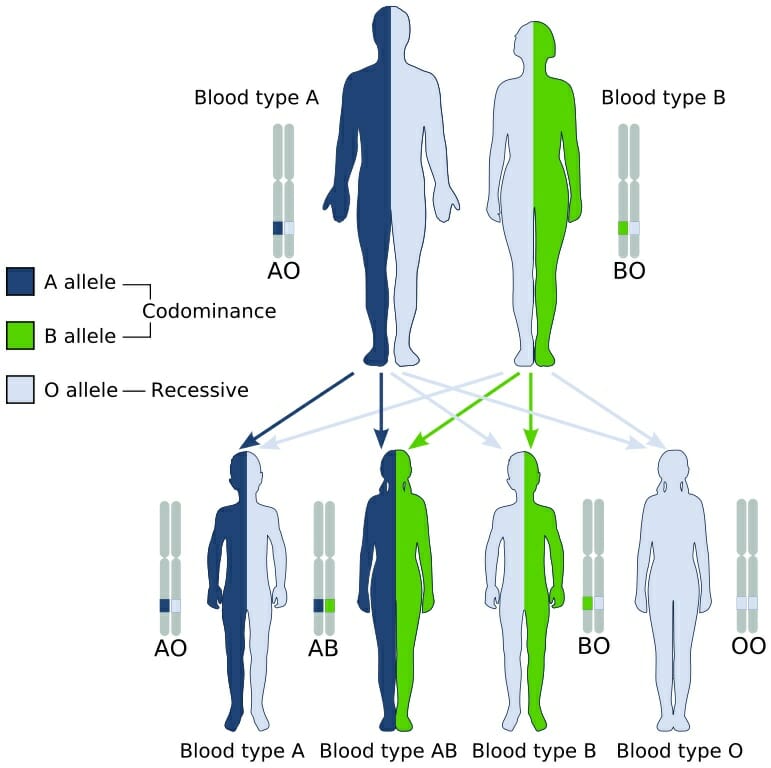
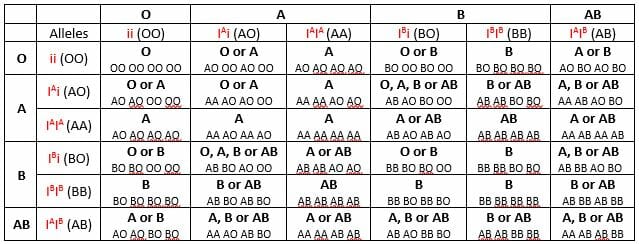
There are three alleles for the ABO gene – IA, IB, and i, which produce type A, type B, and type O blood, respectively. IA and IB are dominant over i, therefore only people with ii (one gene from each parent) have type O blood. People who have IAIA are type A, IBIB are type B, and IAIB gives type AB. Since both IA and IB are dominant, if a person has this allele pair there is codominant expression, meaning both are expressed equally, resulting in type AB blood (see Figure 1). Table 1 below shows the allele combinations offspring can inherit based on the genes of the parents.


ABO system codominance

Figure 1 – The image above Illustrates the codominant inheritance of ABO blood groups.


Blood group inheritance from parents to offspring

Table 1 – Blood group inheritance from parents to offspring. The 4 pairs of alleles in smaller font are the genotypes based on the parental alleles. Note the only way the result will be type O with no other possibility is when both parents are homozygous recessive for type O. Otherwise, A or B dominate or are codominant as type AB.


The Rh Factor


Besides their ABO blood group, a person’s blood type also includes a plus or minus sign (+ or -) indicating whether they have the Rh antigen (a protein) on their red blood cells, also discovered by Karl Landsteiner. There are 2 alleles on the short arm of chromosome 1 of each parent, showing that the Rh factor is inherited independently from the blood type. The Rh- allele is recessive, so for a person to have this blood group, their genotype must be Rh-/Rh-. To be Rh+, a person must inherit at least one Rh+ allele; i.e., Rh+/Rh+ or Rh+/Rh-. There are 35 human blood group systems, and ABO and Rh are the two most important for transfusions and transplants.


References


  • ABO Blood Group System. (n.d.). In Wikipedia. Retrieved March 28, 2018 from https://en.wikipedia.org/wiki/ABO_blood_group_system

  • Lawler, S.D. and Berkman, E. M. (2018). Blood Group. In Encyclopedia Britannica. Retrieved from https://www.britannica.com/science/blood-group


Blood Type Heredity

Herbaceous Plants Examples

Herbaceous plants don’t have hard, woody stems and their buds don’t survive winter above ground. Woody plants, in contrast, survive the winter above ground and they include many species of trees, shrubs, and vines. The wood in their stems is made of secondary xylem (plant vascular tissue that grows in rings) and is often covered with bark. That woody plants survive year to year and continue to grow makes them the tallest and largest types of plants on Earth.


Types of Herbaceous Plants


Herbaceous plants are also known as herbs. Whether they are perennial, annual, or biennial depends partially on the zone they are grown in based on the USDA Plant Hardiness Zone Map. It all depends on whether the plant can survive frost and frigid winter temperatures. For example, basil is a perennial in USDA hardiness zones 10 and above where frost is rare. It’s an annual in zones below 10 where frost and colder temperatures are more common. Therefore, the list of annual plants below is based on USDA hardiness zones 10 and below.


Perennial Herbaceous Plants


Perennial herbs have roots that survive winter below the ground and allow the plants to regrow in the spring. Some examples of perennial herbaceous plants are columbine, daisies, delphiniums, mums, peonies, salvia, potatoes, hostas, mint, catnip, tarragon, ferns, and most grasses.


Annual Herbaceous Plants


Annual herbaceous plants die in winter or after they have produced flowers and fruit, so they must be replanted each year. Examples of these are basil, winter savory, dill, marjoram, fennel, German chamomile, chervil, and cilantro.


Biennial Herbaceous Plants


Biennial herbs are like perennials in that their parts that grow below ground survive the winter, but they flower and die in their second year. Examples of these are carrots, stevia, spinach, lettuce, sage, parsley, parsnips, Black-Eyed Susan, ragwort, and onions. The underground parts of perennial and biennial herbs that live through winter include bulbs, corms, stolons, rhizomes, and tubers.


Reference


  • Herbaceous Plant. (n.d.). In Wikipedia. Retrieved March 29, 2018 from https://en.wikipedia.org/wiki/Herbaceous_plant

  • USDA Plant Hardiness Zone Map. (n.d.). United States Department of Agriculture Research Service. Retrieved from http://planthardiness.ars.usda.gov/PHZMWeb/


Herbaceous Plants Examples