Sunday, March 19, 2017

Taxonomy

Taxonomy Definition


Taxonomy is the branch of biology that classifies all living things. It was developed by the Swedish botanist Carolus Linnaeus, who lived during the 18th Century, and his system of classification is still used today. Linnaeus invented binomial nomenclature, the system of giving each type of organism a genus and species name. He also developed a classification system called the taxonomic hierarchy, which today has eight ranks from general to specific: domain, kingdom, phylum, class, order, family, genus, and species.


The Taxonomic Hierarchy


A taxon (plural: taxa) is a group of organisms that are classified as a unit. This can be specific or general. For example, we could say that all humans are a taxon at the species level since they are all the same species, but we could also say that humans along with all other primates are a taxon at the order level, since they all belong to the order Primates. Species and orders are both examples of taxonomic ranks, which are relative levels of grouping organisms in a taxonomic hierarchy. The following is a brief description of the taxonomic ranks that make up the taxonomic hierarchy.


Domain


A domain is the highest (most general) rank of organisms. Linnaeus did invent some of the taxonomic ranks, but he did not invent the domain rank, which is relatively new. The term domain wasn’t used until 1990, over 250 years after Linnaeus developed his classification system in 1735. The three domains of life are Bacteria, Archaea, and Eukaryota. Archaea are single-celled organisms similar to bacteria; some archaea live in extreme environments, but others live in mild ones. Eukaryota, or every living thing on earth that is not a bacterium or archaeon, is more closely related to the domain Archaea than to Bacteria.


Taxonomic ranks are always capitalized, except for species. This allows people to differentiate between bacteria (the organisms; could refer to all bacteria or just two specific bacteria) and Bacteria (the domain, which includes all bacteria).


Kingdom


Before domains were introduced, kingdom was the highest taxonomic rank. In the past, the different kingdoms were Animalia, Plantae, Fungi, Protista, Archaea, and Bacteria (Archaea and Bacteria were sometimes grouped into one kingdom, Monera). However, some of these groupings, such as Protista, are not very accurate. Protista includes all eukaryotic organisms that are not animals, plants, or fungi, but some of these organisms are not very closely related to one another. There is no set agreement on the kingdom classification, and some researchers have abandoned it altogether. Currently, it continues to be revised; in 2015 researchers suggested splitting Protista into two new kingdoms, Protozoa and Chromista.


Phylum


Phylum (plural: phyla) is the next rank after kingdom; it is more specific than kingdom, but less specific than class. There are 35 phyla in the kingdom Animalia, including Chordata (all organisms with a dorsal nerve cord), Porifera (sponges), and Arthropoda (arthropods).


Class


Class was the most general rank proposed by Linnaeus; phyla were not introduced until the 19th Century. There are 108 different classes in the kingdom Animalia, including Mammalia (mammals), Aves (birds), and Reptilia (reptiles), among many others. The classes of Animalia that Linnaeus proposed are similar to the ones used today, but Linnaeus’ classes of plants were based on attributes like the arrangement of flowers rather than relatedness. Today’s classes of plants are different than the ones Linnaeus used, and classes are not frequently used in botany.


Order


Order is more specific than class. Some of Linnaeus’ orders are still used today, such as Lepidoptera (the order of butterflies and moths). There are between 19-26 orders of Mammalia, depending on how organisms are classified—sources differ. Some orders of Mammalia are Primates, Cetaceans (whales, dolphins, and porpoises), Carnivora (large carnivores/omnivores), and Chiroptera (bats).


Family


Family is, in turn, more specific. Some families in the order Carnivora, for example, are Canidae (dogs, wolves, foxes), Felidae (cats), Mephitidae (skunks), and Ursidae (bears). There are 12 total families in the order Carnivora.


Genus


Genus (plural: genera) is even more specific than family. It is the first part of an organism’s scientific name using binomial nomenclature; the second part is the species name. An organism’s scientific name is always italicized, and the genus name is capitalized while the species name is not. Genus and species are the only taxonomic ranks that are italicized. The scientific name for humans is Homo sapiens. Homo is the genus name, while sapiens is the species name. All other species in the genus Homo are extinct. Some were ancestral to humans, such as Homo erectus. Others lived at the same time, were closely related, and interbred with Homo sapiens, such as Homo neanderthalensis, the Neanderthals.


Species


Species is the most specific major taxonomic rank; species are sometimes divided into subspecies, but not all species have multiple forms that are different enough to be called subspecies. There are an estimated 8.7 million different species of organisms on Earth, but the vast majority have yet to be discovered and categorized. While each genus name is unique, the same species names can be used for different organisms. For example, Ursus americanus is the American black bear, while Bufo americanus is the American toad. The species name is always italicized, but never capitalized. It is the only taxonomic rank that is not capitalized. In scientific articles where the species name is used many times, it is abbreviated after the first full use by using just the first letter of the genus name along with the full species name. Homo sapiens is abbreviated to H. sapiens.


Examples of Taxonomy


The scientific classification of humans is as follows:


  • Domain: Eukaryota

  • Kingdom: Animalia

  • Phylum: Chordata

  • Class: Mammalia

  • Order: Primates

  • Family: Hominidae

  • Genus: Homo

  • Species: sapiens


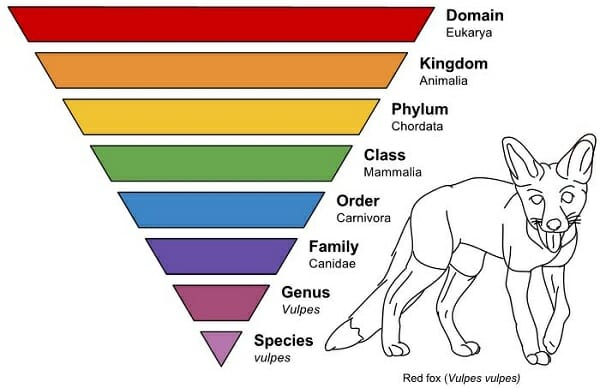
Another example of taxonomy is the diagram below, which shows the classification of the red fox, Vulpes vulpes (sometimes the genus and species names are the same, even though these are two different ranks).


Taxonomic Rank Graph

Many mnemonic devices can be used to remember the order of the taxonomic hierarchy, such as “Dear King Philip Came Over For Good Spaghetti”.

Related Biology Terms


  • Taxon – A population of organisms that has been grouped together by taxonomists.

  • Binomial nomenclature – A two-part system of naming species; species are referred to by their genus name followed by their species name.

  • Taxonomic hierarchy – An ordered group of taxonomic ranks used to classify organisms from general to specific.

  • Taxonomic rank – A level of a group of organisms in a taxonomic hierarchy.

Quiz


1. Which taxonomic rank is more specific than order but less specific than genus?
A. Species
B. Family
C. Class
D. Domain

Answer to Question #1

2. What is the scientific name for humans?
A. Homo habilus
B. Homo erectus
C. Homo sapiens
D. Homo sapiens

Answer to Question #2

3. Why is taxonomic classification used?
A. It allows each species to be uniquely identified.
B. It gives us an idea of how closely two organisms are related.
C. It has been unnecessary to change taxonomy since Linnaeus invented it in the 18th Century.
D. Choices A and B

Answer to Question #3


Taxonomy

Chloroplast

Chloroplast Definition


The chloroplast, found only in algal and plant cells, is a cell organelle that produces energy through photosynthesis. The word chloroplast comes from the Greek words khloros, meaning “green”, and plastes, meaning “formed”. It has a high concentration of chlorophyll, the molecule that captures light energy, and this gives many plants and algae a green color. Like the mitochondrion, the chloroplast is thought to have evolved from once free-living bacteria.


Function of Chloroplasts


Chloroplasts are the part of plant and algal cells that carry out photosynthesis, the process of converting light energy to energy stored in the form of sugar and other organic molecules that the plant or alga uses as food. Photosynthesis has two stages. In the first stage, the light-dependent reactions occur. These reactions capture sunlight through chlorophyll and carotenoids to form adenosine triphosphate (ATP, the energy currency of the cell) and nicotinamide adenine dinucleotide phosphate (NADPH), which carries electrons. The second stage consists of the light-independent reactions, also known as the Calvin cycle. In the Calvin cycle, the electrons carried by NADPH convert inorganic carbon dioxide and to an organic molecule in the form of a carbohydrate, a process known as CO2 fixation. Carbohydrates and other organic molecules can be stored and used at a later time for energy.


Chloroplasts are essential for the growth and survival of plants and photosynthetic algae. Like solar panels, chloroplasts take light energy and convert it into a usable form that powers activities. However, a few plants no longer have chloroplasts. One example is the parasitic plant genus Rafflesia, which obtains its nutrients from other plants—specifically, Tetrastigma vines. Since Rafflesia gets all of its energy from parasitizing another plant, it no longer needs its chloroplasts, and has lost the genes coding for the development of the chloroplast over a long period of evolutionary time. Rafflesia is the only genus of land plant known to be lacking chloroplasts.


Structure of Chloroplasts


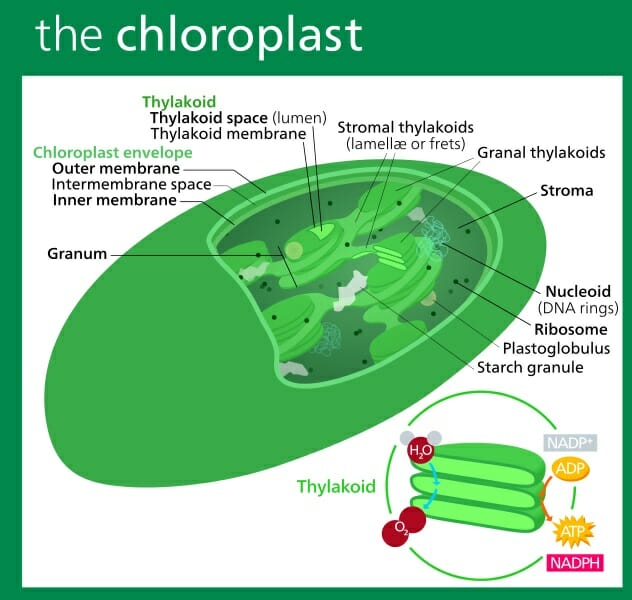
Chloroplasts, like mitochondria, are oval-shaped and have two membranes: an outer membrane, which forms the external surface of the chloroplast, and an inner membrane that lies just beneath. Between the outer and inner membrane is a thin intermembrane space about 10-20 nanometers wide. The space within the inner membrane is called the stroma. While the inner membranes of mitochondria have many folds called cristae to absorb surface area, the inner membranes of chloroplasts are smooth. Instead, chloroplasts have many small disc-shaped sacs called thylakoids within their stroma.


In vascular plants and green algae, the thylakoids are stacked on top of one another, and a stack of thylakoids is called a granum (plural: grana). The thylakoids contain chlorophylls and carotenoids, and these pigments absorb light during the process of photosynthesis. Light-absorbing pigments are grouped with other molecules such as proteins to form complexes known as photosystems. The two different kinds of photosystems are photosystems I and II, and they have roles in different parts of the light-dependent reactions.


In the stroma, enzymes make complex organic molecules that are used to store energy, such as carbohydrates. The stroma also contains its own DNA and ribosomes that are similar to those found in photosynthetic bacteria. For this reason, chloroplasts are thought to have evolved in eukaryotic cells from free-living bacteria, just as mitochondria did.


Chloroplast

This diagram shows the parts of a chloroplast.


Evolution of Chloroplasts


Chloroplasts are thought to have become a part of certain eukaryotic cells in much the same way as mitochondria were incorporated into all eukaryotic cells: by existing as free-living cyanobacteria that had a symbiotic relationship with a cell, making energy for the cell in return for a safe place to live, and eventually evolving into a form that could no longer exist separately from the cell. This is called the endosymbiotic theory.


The evidence that chloroplasts evolved from bacteria is very similar to the evidence that mitochondria evolved from bacteria. Chloroplasts have their own, separate DNA that is circular, like that of a bacterial cell, and inherited maternally (only from the mother plant alga). New chloroplasts are formed through binary fission, or splitting, which is how bacteria reproduce. These forms of evidence are also found in mitochondria. The one difference is that chloroplasts are believed to have evolved from cyanobacteria, while mitochondria evolved from aerobic bacteria. (Mitochondria cannot photosynthesize; the process of cellular respiration occurs there instead.) The structure of chloroplasts is similar to that of cyanobacteria; both have double membranes, circular DNA, ribosomes, and thylakoids. Most chloroplasts are believed to have come from one common ancestor that engulfed a cyanobacteria between 600-1600 million years ago.


Related Biology Terms


  • Thylakoid – Flattened disks within the stroma of the chloroplast that contain chlorophyll and carotenoids, and perform photosynthesis.

  • Photosynthesis – The conversion of light energy into chemical energy in the form of organic molecules.

  • Symbiotic relationship – A close biological interaction between two different species.

  • Algae – A large group of photosynthetic organisms including seaweeds, giant kelp, and diatoms.

Quiz


1. What is a difference between mitochondria and chloroplasts?
A. Chloroplasts have an outer and inner membrane, while mitochondria do not.
B. Chloroplasts are thought to have evolved from bacteria, while mitochondria are not.
C. Photosynthesis occurs in chloroplasts, but not in mitochondria.
D. Mitochondria have their own DNA; chloroplasts do not contain DNA.

Answer to Question #1

2. In which part of the chloroplast does photosynthesis occur?
A. Outer membrane
B. Thylakoid
C. Stroma
D. Intermembrane space

Answer to Question #2

3. What are chloroplasts thought to have evolved from?
A. Aerobic bacteria
B. Cyanobacteria
C. Algae
D. The Rafflesia plant

Answer to Question #3


Chloroplast

Oviparous

Oviparous Definition


An oviparous animal is one that produces eggs, and the young hatch after being expelled from the body. While fertilization of the egg can occur internally or externally, oviparous animals always hatch their young outside of their body. Many amphibians, birds, fish and reptiles are oviparous and often make nests to protect their eggs. This can be contrasted to ovoviviparous animals, which hatch eggs inside of their bodies, then expel live young. This can be seen in some sharks, snakes, and other animals.


Being oviparous is an evolutionary strategy for reproduction. In this strategy, one or many eggs can be produced. Each egg is a gamete that has the female’s contribution of the genetic material. In many species, the male supplies his gamete in the form of sperm, which must find its way to the egg. Once fertilized, the cells within the egg will begin to subdivide as an embryo is formed. Many oviparous animals choose to make many small, fragile eggs. Other oviparous animals choose to protect a few very strong, large eggs. There are advantages to both. Many eggs results in many offspring at once, and many offspring can overcome a few predators. On the other hand, a large protected egg increased the development of the offspring and the chances it will survive until birth. This advantage may make the offspring large enough to escape potential predators and accidents after birth.


Much like the other reproductive strategies, being oviparous has its downsides as well. Unlike viviparous and ovoviviparous animals which carry their developing young with them, oviparous animals must protect or hide their eggs for the duration of development. Many birds must sit on their eggs frequently to keep them warm, or even constantly in the case of cold-climate birds like penguins. In the case of animals that don’t watch their eggs, there is always the chance of a predator stumbling upon the nest and eating their whole clutch (batch of eggs).


Examples of Oviparous


Example #1: Oviparous Birds


The most recognizable oviparous animal is the chicken. Chickens develop an egg in one of their ovaries, which will descend to be laid whether or not it becomes fertilized. If it does become fertilized, the young embryo develops inside the egg, feeding off of the nutrient-rich yolk sack inside the egg. Once mostly developed, the small bird hatches, ready to walk and eat. Birds are oviparous in general, and lay hard-shelled eggs that have been fertilized internally. Many of the young are precocial, or have the ability to walk and feed immediately upon hatching.


Example #2: Oviparous Reptiles


Reptiles use very similar methods of developing their young. The main difference is that reptile eggs often have a much softer shell, often leathery to the touch. Still, like birds, the eggs are incubated in a nest. Where birds prefer to sit on their nests to provide warmth to the eggs, reptiles tend to bury their eggs completely in burrows or mounded nests. This tends to keep the eggs at a stable temperature. Reptiles tend to need a stable environment for their eggs because the sex of the young is dependent on the temperature during critical periods of the embryotic development. This is known as temperature dependent sex determination.


Example #3: Oviparous Fish and Amphibians


While birds and reptiles use internal fertilization, it is not necessary to be oviparous. Many female fish lay eggs in a nest. The males immediately swoop in to fertilize the eggs by casting their sperm over the nest. In this case both male and female cast their gametes (eggs and sperm) into the environment in the hopes that they will find each other. Some fish are very successful in this, and have complex nests and mating strategies to ensure the gametes meet. Other fish use complex mating dances to release their gametes in unison, thereby increasing the chances of fertilization.


Most amphibians are oviparous as well, laying their eggs in ponds or other sources of standing water. Fertilization in amphibians is mostly external. Unlike reptiles and birds, amphibians often emerge from the egg in a larval form. This form has a tail and gills, which allow it to continue developing in the pond or body of water it was born in. Eventually the tadpole or larva will metamorphose into the adult form, losing its tail and growing large limbs.


Related Biology Terms


  • Ovoviviparous – A reproductive strategy in which an animal forms an egg, the egg is fertilized and develops inside of the egg, inside of the female, then live young are hatched from the female. In this method embryos feed off of the yolk sack inside of the egg.

  • Viviparous – A reproductive strategy in which an animal fertilizes a gamete inside of the female. The gamete then develops in a special chamber, such as a uterus in mammals, or a chamber in which nutrients are circulated.

  • Precocial – Newborns with the ability to move and eat. Often in birds and reptiles, these young are able to make calls to find their parents.

  • Gametes – The single reproductive unit of any sexually reproducing animal. A gamete has only half of the genetic material needed to create an entire organism, in the case of mammals: egg and sperm.

Test Your Knowledge


1. An alien on a planet far away reproduces by the following method: a female produces a gamete internally, which is fertilized by the male. The gamete is given a protective covering and placed in a burrow. The burrow is covered and the male and female move on to make more burrows. What type of reproduction would a scientist from Earth say they have?
A. Ovoviviparous
B. Viviparous
C. Oviparous

Answer to Question #1

2. A special order of mammals, known as the Monotromes, lay eggs instead of giving birth to live young like most mammals. Monotremes include strange animals like the platypus and echidna. However, once hatched from the egg, the young are fed on a milk that is secreted from glands in the skin of the mother. How would you classify the Monotremes?
A. Viviparous
B. Ovoviviparous
C. Oviparous

Answer to Question #2

3. Is it better to lay 1,000 decent eggs, or to lay 1 really big, strong egg?
A. The strong egg! Protect your babies.
B. Strength in numbers! Lay as many as you can.
C. It depends…

Answer to Question #3


Oviparous

Sunday, March 12, 2017

Homoplasy

Homoplasy Definition


A homoplasy is a shared character between two or more animals that did not arise from a common ancestor. A homoplasy is the opposite of a homology, where a common ancestor provided the genes that gave rise to the trait in two or more animals. Often, a homoplasy will occur when two very different groups of animals evolve to do the same thing. This is known as convergent evolution, or convergence. Sometimes, a homoplasy trait is called an analogous trait. The best way to gain an understanding of what is and is not a homoplasy is to go over some examples.


Homoplasy Examples


Example #1: Homoplasy in Wings


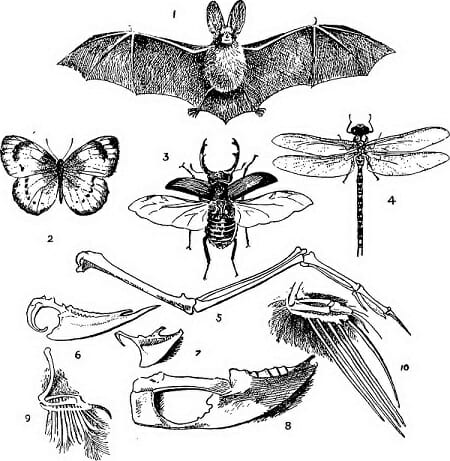
The easiest homoplasy to understand is the trait of wings. Throughout the animal kingdom, wings have evolved in a number of various shapes and materials, but their fundamental function is the same: flight. Birds, bats, and many insects have evolved wings. In each case, the trait evolved independently of the other groups. The closest common ancestor of birds, bats and insects most certainly did not have wings. After the lineages diverged, or headed off in their own direction, a similar pressure of flight being advantageous caused all lineages to develop flight.


The British bird book


In each case, they also found their own way to develop wings. Bird wings are specially adapted forelimbs covered in feathers. The tarsals and metatarsals (hand and wrist bones) are formed in birds in such a way that they effectively have no fingers, but instead have an elongated limb that forms a strong leading edge for the wing. The feathers serve to give wing structure and, in this way, lift is generated, much like by the wings of an airplane.


Bats, like birds, also have modified wrist and finger bones. Unlike birds, bats do not have feathers, as this trait never evolved in bats. Because of this, bats support their wings with very long finger bones, or tarsals. Thus, in the same way as birds, bats create lift with their wings and are able to fly. Insects are another group of animals with the ability to fly, and their wings are even more complex.


Because of the complexity of the insect world, it is not certain whether insect wings are a homoplasy or a homology. Imagine butterfly wings. If you were to look up close, you would see that these enormous wings (compared to the insect) are covered in small scales, which make beautiful colors. The butterfly flaps them slowly and seems to glide through the air with ease. Compare these enormous, beautiful wings to those of a beetle. The beetle, to get his wings out, must open his hard outer covering and unfold or expand his much more fragile wings. They are thin, translucent (you can see through them), and they do not appear strong enough to be able to carry the beetle. Then, the beetle flaps them at an enormous rate and is quickly carried away by the lift they generate.


To determine whether beetle and butterfly wings are a homoplasy or a homology, scientists must look at the genetic lineage of beetles and butterflies and determine if their common ancestor is the reason they have wings. Although wings in insects were once thought as a completely homologous trait, more genetic evidence has begun to show that wings have evolved multiple times in insects.


Example #2: Homoplasy in Beaks


While not an often cited homoplasy, a squid and a falcon share a trait. At the opening of their mouth is a large beak, often sharp and meant to tear their prey apart. However, it can be seen immediately from their forms, locations of living, and closest genetic relatives, that the octopus and the falcon did not get their beaks from a common ancestor. The beaks evolved through convergence, or in other words, a similar need to rip throat-sized chunks from a prey animal. While it might not be pretty, evolution does tend to produce similar results given similar circumstances.


Example #3: Not a Homoplasy


Now that you have a decent understanding of what a homoplasy is, let’s go over what it is not. Any time the trait is passed from parent to offspring, the trait is not a homoplasy. If a parent passes the trait to their offspring, the trait is a homology. When the trait gets passed down a long line of ancestors, the descendants can start to vary from each other in many ways. However, if they both still possess the trait, it is still a homologous trait, and not a homoplasy.


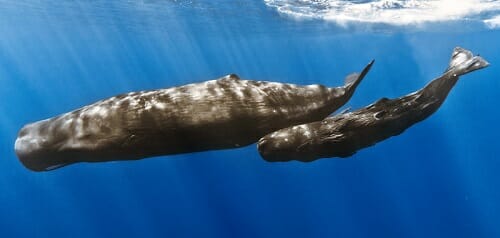
For instance, we are all familiar with mammals. Scientist, through years of study of their defining traits, and more recently, confirmations provided by genetic testing, have shown that mammals are a definable group of animals. These animals, by definition, have mammary glands which they use to feed their young. Although the mammary glands of whales and cows look different, and function in different ways, they are evolved from a common ancestor that had a primitive form of mammary glands. Therefore, mammary glands in whales and cows are homologous, not homoplastic.


Sperm whale mother with calf

Sperm whale mother with calf


Related Biology Terms


  • Homology – The opposite of a homoplasy, a homology is when a shared trait is due to a common ancestor passing the trait on to two or more lineage.

  • Common Ancestor – In evolution, when comparing two or more organisms, the common ancestor is the organism through which the organisms being compared are related.

  • Lineage – A line of organisms that connects past ancestors to living organisms.

  • Selection – Forces that allow some organisms to reproduce more than others.

Test Your Knowledge


1. Which of the following is NOT a homoplasy?
A. Mammary glands in hippos and deer.
B. Fins in fish and dolphins.
C. Wings in beetles and bats.

Answer to Question #1

2. Octopi and humans both have very advanced eyes, capable of seeing colors and following moving objects. The most recent common ancestor between octopi and humans did not have eyes (hypothetically). Are eyes in humans and octopi a homology or a homoplasy?
A. Homology
B. Homoplasy
C. Neither, this is a trick question.

Answer to Question #2

3. Two new species of frog are discovered in the rainforest. We decide to call them Froggy1 and Froggy2. Both species have bright orange spots on their backs, which help deter predators from eating them. It is thought that the frogs share a homologous trait, the spots, and that they are related. Genetic testing is done on the frogs and it shows that the frogs are not related, and haven’t been since before frogs looked like frogs. What does this tell us about the spots?
A. The spots cannot be from a recent common ancestor, therefore they are a homoplasy, evolved by convergence, or conditions that drove both frogs to evolve spots.
B. They’re both frogs, right? Must be a homologous trait.
C. What are you people talking about?

Answer to Question #3


Homoplasy

Tuesday, March 7, 2017

Sylph


Hidden just inside the clouds is a thriving society of ethereal beings, so pure that they cannot be seen by the eyes of men. Still, the invisible Sylphs have managed to captivate the imagination of people for over six centuries, inspiring songs, debates, dances, and even occult rituals.


What Is a Sylph?


A Sylph (also known as Sylphid) is an air spirit. They are formed of air, they live in the air, and they have unusual power over the air, particularly the wind and the clouds. Usually, Sylphs are portrayed as guardians who protect secret knowledge, beautiful women, or the environment, but it’s not out of the question for a Sylph to cause mischief among men.


Characteristics


Physical Description


From the dawn of Sylph mythology in the 16th century, and throughout the classical era, Sylphs have been described as being something between a spirit and a creature. While they are invisible to human beings, they do have physical bodies—usually coarse, humanoid shapes that are larger and stronger than those of regular humans.


As the curtain closed on the classical era, Sylphs materialized in the spotlight of the romantic era’s operas and ballets. Here, not surprisingly, Sylphs take on a more romantic shape; they are dainty, fairy-like creatures with graceful wings.


Today, the word Sylph is tagged onto slender, attractive young females, much like the ballerinas who portrayed Sylphs during the romantic period. However, a camp of believers in the original Sylph still puts out a large volume of photos every year, claiming that they have captured one of the elusive Sylphs leering down from the clouds.


Special Abilities


Sylphs have more than just invisibility and brawn going for them. They also have a type of intelligence that men lack. They are born understanding the universe and the connections between all its parts, and they may know of ways of manipulating those parts to cause specific effects, knowledge which caused many alchemists to pursue them throughout the classical era. Perhaps the most impressive aspect of Sylph intelligence is their supernatural foresight. The future holds few mysteries for a Sylph.


Weaknesses


According to early mythology, Sylphs are only capable of moving freely through the air. They drown in water, burn in fire, and become trapped in earth, so they are basically powerless outside of their own element.


Early mythology also states that Sylphs are mortal in both body and soul. They can die from hunger, illness, or physical injury. Because they lack a soul, when they die, they simply cease to exist. Luckily, there is a loophole for Sylphs who marry humans; the Sylph might gain an immortal soul through the marriage. At the very least, the couple’s children will have immortal souls.


Related Characters


According to early Sylph mythology, the Sylph is one of four creatures, called elementals, who embody the cardinal elements. Sylphs, of course, embody air, while gnomes embody earth, salamanders embody fire, and undines embody water. The elementals guard great treasures of power and knowledge, which are hidden in the pure worlds of each element.


Occasionally, all of the elementals are capable of giving rise to monstrous offspring. The birth of one of these monsters is rare and apparently spontaneous, but disaster usually follows at their heels. When a Sylph delivers one of these monsters, it takes the form of a giant.


Over time and through cultural shifts, the Sylph became estranged from the other three elementals and were linked, instead, to air spirits like fairies and pixies. They also filled the void left by the sirens of classical mythology, becoming a slightly more innocent version of the seductive, magical creature who lures men to their doom.


Cultural Representation


Origin


Sylphs make their debut on the pages of the Liber de Nymphis, which was penned during the 16th century by Paracelsus, a renowned Swiss-German occultist. Not only was Paracelsus the first to refer to Sylphs in writing, he gave such a definitive study of them that his name became a fixture in Sylph mythology. For hundreds of years, no discussion of Sylphs failed to include Paracelsus’ name.


Paracelsus himself made no claims about seeing Sylphs. Instead, he credited his knowledge of these air spirits to folklore; his study of the Sylph attempted to fit accounts from folklore into his own worldview. By the end of his analysis, Paracelsus made it clear that his own understanding of Sylphs was much more advanced than the folklore he had based his ideas on, stating that, “The names have been given [to Sylphs] by people who did not understand them.”


Classical Era


The political turmoil of the early 17th century created a hotbed for cults who offered clarity and knowledge to their followers. The Sylph, who was believed to possess both, emerged as a figurehead of some prominent cult movements, including Rosicrucianism.


The Rosicrucians claimed to be capable of seeing Sylphs, as well as the other elementals, by treating their eyes with alchemical medicines or gazing into crystal balls. Many Rosicrucians took chastity vows, hoping to marry an elemental.


Romantic Era


By the time the 19th century rolled around, bringing greater stability to European society, the occult beliefs that had raged during the 17th century had become the stuff of satire.

The Sylph found a safe-haven in the theaters of the romantic period. They appeared as charming, ethereal, and ultimately unattainable women in multiple operas and ballets. Perhaps the most famous ballet was La Sylphide, which immortalized the image of the graceful, fairy-like Sylph.


Modern Era


Thanks to Vladimir Nabokov’s society-shaking novel, Lolita, most people today would define a “sylph” as an enchanting, slightly devious young girl.


Role-playing games, like Dungeons and Dragons, have stayed truer to the original meaning of the word “sylph.” Players often incorporate Sylphs into their games as strong, magical creatures with power over the wind.


There are still some pockets of believers in the elemental Sylph. They frequently photograph Sylphs in the clouds and describe the Sylph as a valiant protector of the environment. One of their pet beliefs is that, in order to eliminate pollution, Sylphs eat the harmful “chemtrails” left behind by airplanes.


Sylph

Friday, March 3, 2017

Secondary Succession

Secondary Succession Definition


One of the two main forms of ecological succession, secondary succession is the process relating to community growth or change that takes place when a habitat is disturbed or damaged.


Whilst primary succession takes place when pioneer species inhabit a newly formed substrate lacking in soil and biotic organisms (such as rock formed from lava flow or areas of glacier retreat), secondary succession occurs on a substrate that has previously supported vegetation but has been altered by processes such as fire, hurricanes, floods or human disturbances.


Secondary succession is usually faster than primary succession because soil and nutrients are already present due to ‘normalization’ by previous pioneer species, and because roots, seeds and other biotic organisms may still be present within the substrate.


Examples of Secondary Succession


Example #1: Fire


Fire is one of the most common causes of secondary succession and is an important component for the renewal and vitality of many types of ecosystem. Fires may either take place naturally, for example when lightning strikes a dry habitat, or may involve controlled, systematic burning of a landscape by humans.


Both the abiotic and biotic components of an ecosystem can be drastically altered by the presence of fire. The most notable abiotic feature that is affected by fire is the soil; CO2, CO and CH4 stored within the organic material is released into the atmosphere during the combustion process; however, this initial loss of nutrients is often counterbalanced and then increased by the decomposition of leftover plant material which leaches N, P and K back in to the soil. The moisture retention of the soil also increases due to the reduction of transpiration by plants, and because more water is allowed to reach the soil surface where interception of rain by leaves is greatly reduced or non-existent. Soil pH often rises (more alkaline) after a fire due to the combustion of acids.


After a fire, species start to recolonize an area, beginning the secondary succession process. The first species to colonize are usually fast growing herbaceous plants, such as conifers or ferns, which require high levels of light. These species are often already present in the form of seeds within the soil, or are able to rapidly disperse from nearby areas. In time, slow growing, shade-tolerant, woody species begin to suppress the early successional species, which are in-turn replaced or shaded by large trees, eventually leading to the generation of forests and a climax community.


The physical and biotic characteristics of an ecosystem, as well as the level of disturbance (determined by the intensity and frequency of fires), create a mosaic of habitats within an area. This mosaic effect allows a more diverse range of species to colonize than in an area that is ecologically stable for a long period of time. The types of plants and animals able to recolonize an area after fire are dependent on the properties of the soil, as well as climate and topography.


Example #2: Harvesting, Logging and Abandonment of Crop Land


The abandonment of land previously utilized for crops is a common cause of human-induced secondary succession. Land which has been intensively cultivated is often nutrient poor, with the nutrients having been repeatedly removed through harvest or logging. Agricultural processes also often leave the soil vulnerable to high levels of erosion. The abandonment of such land allows plants and animals that were previously unable to inhabit the area to colonize. Early succession of vegetation following the abandonment of farmland is responsible for increases in soil organic content, nutrient density and soil porosity. The addition of shrubs and of root systems within the soils, which follow in later succession, acts as a natural barrier against erosion, thereby allowing for restoration of degraded habitats.


The process of secondary succession on human altered landscapes differs to that of succession after a natural event due to the homogenization of soil type and nutrients, especially where artificial fertilizers have been applied. This can lead to the exclusive colonization of an area by generalist species, which slows the succession process and does not allow for such high biodiversity.


Example #3: Renewal After Disease


If a disease affects all of a certain species within an area, the species is likely to experience a rapid die-off. Although the onset of disease can be a catastrophic event for a particular species, once the living crop has entirely died off and the disease therefore eradicated, if the roots or seeds remain in the soil, the crop can repopulate. Alternatively, the disease can kill enough of a species to allow for invasion by species which may have been previously unable to colonize, which in turn enables a more diverse range of species to inhabit an area.


Example #4: Gap Dynamics


Although secondary succession can happen on a large scale and have an intense effect on a habitat or ecosystem, it is most common on a small scale. The disturbance and subsequent secondary succession that occurs after a gap is created in a forest canopy, following the death and collapse of a single tree or the loss of a large branch, is known as gap dynamics; the effect is often most prevalent in dense forests. The creation of a gap in a canopy allows light to penetrate to the forest floor, giving herbs, shrubs, vines and seedlings an opportunity to exploit the new resource. After a few years, fast growing, taller plants begin to dominate the lower canopy, suppressing the growth of the shade-intolerant species of the lowest canopy level but allowing shade-tolerant species to thrive. Heliophilic (sun-loving) species begin to dominate the top of the canopy after around 75-150 years, while the shade-tolerant species of the lower canopies establish a stable community. This stable state is known as a climax community, and will remain in equilibrium until a new canopy gap is created.


Related Biology Terms


  • Primary Succession – The type of succession that occurs on a new rock or substrate devoid of vegetation or other organisms.

  • Climax Community – The state of relative stability or equilibrium of species composition, occurring when a community does not experience any disturbance for long periods of time.

  • Pioneer Species – The hardy species that are first to colonize a newly disturbed or formed habitat, beginning the process of ecological succession.

  • Ecological Disturbance – A temporary change within a habitat, that causes notable differences to an ecosystem’s biotic or abiotic elements.

Test your knowledge


1. Which types of plants are likely to colonize a disturbed habitat first?
A. Tall, hardwood trees
B. Herbaceous plants
C. Shade tolerant plants
D. None of the above

Answer to Question #1

2. Which of the following scenarios would not create a habitat suitable for secondary succession?
A. Hurricane
B. Forest fire
C. Volcanic eruption
D. Logging/Deforestation

Answer to Question #2

3. Secondary succession does not directly affect:
A. Rainfall
B. Species diversity
C. Soil nutrients
D. Soil moisture content

Answer to Question #3


Secondary Succession

Thursday, March 2, 2017

Electron Transport Chain

Electron Transport Chain Definition


The electron transport chain is a cluster of proteins that transfer electrons through a membrane to create a gradient of protons that creates ATP (adenosine triphosphate) or energy that is needed in metabolic processes for cellular function. During the process, a proton gradient is created when the protons are pumped from the mitochondrial matrix into the intermembrane space of the cell, which also helps in driving ATP production. Often, the use of a proton gradient is referred to as the chemiosmotic mechanism that drives ATP synthesis since it relies on a higher concentration of protons to generate “proton motive force”. The amount of ATP created is directly proportional to the amount of protons that are pumped across the inner mitochondrial membrane.


The electron transport chain involves a series of redox reactions that relies on protein complexes to transfer electrons from a donor molecule to an acceptor molecule. As a result of these reactions, the proton gradient is produced, enabling mechanical work to be converted into chemical energy, allowing ATP synthesis. The complexes are embedded in the inner mitochondrial membrane called the cristae in eukaryotes. Enclosed by the inner mitochondrial membrane is the matrix, which is where necessary enzymes such as pyruvate dehydrogenase and pyruvate carboxylase are located. The process can also be found in photosynthetic eukaryotes in the thylakoid membrane of chloroplasts and in prokaryotes, but with modifications.


By-products from other cycles and processes, like the citric acid cycle, amino acid oxidation, and fatty acid oxidation, are used in the electron transport chain. As seen in the overall redox reaction,


2 H+ + 2 e+ + ½ O2 → H2O + energy


energy is released in an exothermic reaction when electrons are passed through the complexes; three molecules of ATP are created. Phosphate located in the matrix is imported via the proton gradient, which is used to create more ATP. The process of generating more ATP via the phosphorylation of ADP is referred to oxidative phosphorylation since the energy of hydrogen oxygenation is used throughout the electron transport chain. The ATP generated from this reaction go on to power most cellular reactions necessary for life.


Steps of the Electron Transport Chain


In the electron transfer chain, electrons move along a series of proteins to generate an expulsion type force to move hydrogen ions, or protons, across the mitochondrial membrane. The electrons begin their reactions in Complex I, continuing onto Complex II, traversed to Complex III and cytochrome c via coenzyme Q, and then finally to Complex IV. The complexes themselves are complex-structured proteins embedded in the phospholipid membrane. They are combined with a metal ion, such as iron, to help with proton expulsion into the intermembrane space as well as other functions. The complexes also undergo conformational changes to allow openings for the transmembrane movement of protons.


These four complexes actively transfer electrons from an organic metabolite, such as glucose. When the metabolite breaks down, two electrons and a hydrogen ion are released and then picked up by the coenzyme NAD+ to become NADH, releasing a hydrogen ion into the cytosol.


The NADH now has two electrons passing them onto a more mobile molecule, ubiquinone (Q), in the first protein complex (Complex I). Complex I, also known as NADH dehydrogenase, pumps four hydrogen ions from the matrix into the intermembrane space, establishing the proton gradient. In the next protein, Complex II or succinate dehydrogenase, another electron carrier and coenzyme, succinate is oxidized into fumarate, causing FAD (flavin-adenine dinucleotide) to be reduced to FADH2. The transport molecule, FADH2 is then reoxidized, donating electrons to Q (becoming QH2), while releasing another hydrogen ion into the cytosol. While Complex II does not directly contribute to the proton gradient, it serves as another source for electrons.


Complex III, or cytochrome c reductase, is where the Q cycle takes place. There is an interaction between Q and cytochromes, which are molecules composed of iron, to continue the transfer of electrons. During the Q cycle, the ubiquinol (QH2) previously produced donates electrons to ISP and cytochrome b becoming ubiquinone. ISP and cytochrome b are proteins that are located in the matrix that then transfers the electron it received from ubiquinol to cytochrome c1. Cytochrome c1 then transfers it to cytochrome c, which moves the electrons to the last complex. (Note: Unlike ubiquinone (Q), cytochrome c can only carry one electron at a time). Ubiquinone then gets reduced again to QH2, restarting the cycle. In the process, another hydrogen ion is released into the cytosol to further create the proton gradient.


The cytochromes then extend into Complex IV, or cytochrome c oxidase. Electrons are transferred one at a time into the complex from cytochrome c. The electrons, in addition to hydrogen and oxygen, then react to form water in an irreversible reaction. This is the last complex that translocates four protons across the membrane to create the proton gradient that develops ATP at the end.


As the proton gradient is established, F1F0 ATP synthase, sometimes referred to as Complex V, generates the ATP. The complex is composed of several subunits that bind to the protons released in prior reactions. As the protein rotates, protons are brought back into the mitochondrial matrix, allowing ADP to bind to free phosphate to produce ATP. For every full turn of the protein, three ATP is produced, concluding the electron transport chain.


ETC electron transport chain


Related Biology Terms


  • Aerobic respiration – The processes of converting energy into ATP in the presence of oxygen.

  • Cytochromes – Proteins that have a prosthetic group, or non-protein molecule, that is required for its activity.

  • Organic metabolite – The intermediate produced in metabolic reactions.

  • Phosphorylation – The process of adding a phosphate to a molecule that often changes its function.

  • Ubiquinone – Substance that accepts electrons from Complexes I and II that is lipid soluble so it can freely move through the membrane.

Test Your Knowledge


1. Complex IV, also known as cytochrome oxidase, performs which reaction?
A. NADH + Q ↔ NAD+ + QH2
B. NADH ↔ NAD+ + 2H+ + 2e
C. 2 H+ + 2 e+ + ½ O2 → H2O + energy
D. 4 H+ + 4 e + O2 → 2 H2O

Answer to Question #1

2. What component(s) is passed to the first complex in the electron transport chain?
A. NADH + H+
B. FADH+
C. Q
D. Cytochrome c

Answer to Question #2

3. Where is the higher concentration of protons while the electron transport chain is activated?
A. Phospholipid layer
B. Mitochondrial matrix
C. Intermembrane space
D. Cell membrane

Answer to Question #3


Electron Transport Chain